QUESTION:...."Many of us working in environmentalism have come to feel that the only (or the best) way we have to protect wildlife is to buy up habitat and easements through organized efforts such as land trusts. At the same time, I am starting to worry that these efforts, because they still buy into the notion of a fair system, may find us down the road having all of the property rights and easements taken away from us (and from the wildlife we are trying to protect) the moment that monied power forces decide they need the land for their own use."
"What should we be prepared for in the future, as land trust members? What chance do you think land trusts have of actually being able to preserve habitat once monied interests begin to perceive it as useful for their own ends?"
Jensen: "I'm all for any tactics that work, and while I definitely see the benefit of buying land and setting it aside, I also see problems associated with it, problems I think are not often enough discussed.
The first is that within an industrial economy, more or less all economic activity is destructive, which means that in order to gain the money to purchase the land in one place you've probably had to harm some other place. For example, I make between $1.50 and $2.25 on every book I've written that sells in a bookstore. Let's call it
$2. There are some people here in Del Norte County in northern California who want to purchase some cutover parcels of 40 or 60 acres. I think the parcels cost something like $40,000. Purchasing and setting aside this land would be a very good thing. The parcels are on a coho-bearing stream, and they are in the midst of a larger parcel recently set aside. But for me to purchase this, twenty thousand of my books would have to sell. How much damage was caused by the manufacture and transportation of those books? It will not be insignificant. And my publisher is a small operation. What if my work were published by Random House? I would be helping a German conglomerate get richer.
My second problem with it is the knowledge that no matter how much I can work to set aside land, the system is rigged in favor of those who purchase land to put it to economic use. Let's say I put out $40,000 to purchase this land. Well, now I have to write more books to purchase more land. Meanwhile, Weyerhaeuser purchases another parcel for $40,000. The company does so in order to turn a profit. That means that by cutting the trees on the land and through government subsidy, Weyerhaeuser will make more than $40,000, and will use that money to purchase and deforest more land. It's inescapable. If you purchase land to set it aside, you can never compete with those who are purchasing it to kill those who live there and convert them to cash.
My third problem with it is that it doesn't challenge the notion that it is acceptable to buy and sell land. Most of us would consider it immoral to buy and sell human beings, and we consider that slaveholders in the nineteenth century were immoral people with whom we have nothing in common. "I, for one," we can say all-too-easily, "would never have done anything like that." But are you sure? Try this. What if instead of owning people we're talking about owning land. Someone tells you that no matter how much you paid to purchase title to some piece of land, the land itself does not belong to you. No longer may you do whatever you wish with it. You may not cut the trees on it. You may not build on it. You may not run a bulldozer over it to put in a driveway. All of those activities are immoral, because they*re based on your exploitation of a living thing: in this case the land. Did you ask the land if it wants you to build on it? Do you care what the land thinks? But the land can't think, you say. Ah, but that's just what you think. It is how you were taught to think. Let's say further that your livelihood and your way of life are based on working this land--the outsiders call it exploiting--and that if the outsiders have their way you'll be out of business. Again and again they tell you that you are a bad person, a stupid bigot, because you refuse to see that your way of life is based on the exploitation of something you don*t perceive as having any rights*or sentience* to begin with. Angry yet?
My point is not that slavery was (or is) moral. It is that our entire way of living has from the beginning been based on slavery, and continues to be. As I mentioned before, there are more human slaves now than came across on the Middle Passage. And what are factory farms, except slave and death camps for nonhumans (I say this, by the way, as someone who eats meat: I try to avoid factory-farmed meat; wild meat is the best of all, except to be honest (and I've never done this) the most ecologically-sound meat you could get would be to poach cows off of state or federal lands)? What are we effectively doing with land ownership? What is privatization? We
are effectively attempting to enslave all of the land (and water and air and genetic materials and all of life) to industrial production.
I want to tell you a parable of stupidity. It centers around a box. The box is full of salmon, and a man sits atop the box. Long ago this man hired armed guards to keep anyone from eating the fish. The many people who sit next to the empty river starve to death. But they do not die of starvation. They die of a belief. Everyone believes that the man atop the box owns the fish. The soldiers believe it, and they will kill to protect the illusion. The others believe it enough that they are willing to starve. But the truth is that there is a box, there is an emptied river, there is a man sitting atop the box, there are guns, and there are starving people.
All of our claims to land ownership are illusory. They are nothing more nor less than social convention. Unfortunately these illusions have real world effects. We allow imaginary institutions called corporations to pretend they own land, and then to destroy the actual living beings on that land because we believe that they own it (and in fact believe that they--corporations--actually exist). One of the most important things we can do is challenge these delusions.
I don't own the land I live on. I believe I own it. More or less all of the humans who live here in this county believe I own it. But the land itself doesn't believe that. If anything it owns me. We are neighbors, close neighbors, living literally on top of each other, and I need to figure out what I can do to help my neighbors live happy and fulfilling lives.
Another problem with purchasing land to set aside is that we all know that if this land were then found to have resources coveted by those in power, that our ownership would be meaningless. They would take the resources, and if we resisted, they would kill us. To convince ourselves of that, we need merely look at the trail of broken treaties, and ask ourselves how fairly Indian land claims have been resolved.
All that said, I consider purchasing land to set aside to be one tactic. I have no problem with the use of this tactic, and in fact if I had boatloads of money I would purchase land left and right to set aside. I just want for us to not unthinkingly use this tactic, any more than I would want for us to unthinkingly use any other
tactic.
I've heard it said that unquestioned assumptions are the real authorities of any culture. The notion of owning land (or owning anything, where we define ownership as the right to control and destroy) is one of the fundamental unquestioned assumptions of our culture."
Derrick Jensen Land Trusts Economics
Saturday, October 28, 2006

Quote and Something to Think About
This post over at Ran Prier has given me a lot to think about. I don't think I have a clear vision. And I liked what Ran had to write about his vision.
October 25. Last week Stacy made a challenging comment:
Aren't eco-villages just another program? Aren't renewable energy schemes another program? Didn't Daniel Quinn point out in 1996 that stuff like that doesn't represent a change in vision? Or we want to go back to a forager lifestyle because it's a known entity instead of trying for a new vision. Is living in an ecovillage or becoming a hunter/forager new? Can that be a vision?
What's your vision? Can you put it into 25 words or less?
Here's what I wrote in my Critique of Civilization FAQ:
[Ran wrote:]Only people under the spell of civilization need an exciting vision of a nonexistent future to motivate them. Cultures that live in balance feel no need for a "vision of the future" because they have a present that is acceptable.
Our visions of the future have all turned out to be wrong. From techno-utopia to Hitler's Thousand Year Reich to the Age of Aquarius to Bush's crusade to bring "freedom" to Asia, they're a mixture of wishful thinking and lies that serve to motivate people to march toward something that turns out to be quite different.
Right now, people with visions are seen as strong and bold, and people who make predictions are seen as weak and passive. That's because we're still deep in the culture of Empire, which gives us a greatly inflated view of our own relative power. The way I see it, we're surfers. We have some choice over where we go, but we have to be patient and work with the waves. We are creating reality not as dictators but as collaborators with all other life from bacteria to gods. I see myself as a scout, looking at the landscape ahead to help people get ready.
At the same time, I do have a vision. From the same essay: "I envision stone age, medieval, modern, and 'magical' technologies all dancing together in a world of wilderness and ruins." Most important, that world must be stable. I'm struggling with a new essay about what that means.
And I just got done reading After Dachau, by Daniel Quinn again, and here are a few gems that I ran across.
“I learned something about obsession with my time with the Fenshaws. I learned it isn’t madness or even foolishness, though madness and foolishness have gvien it a bad name. How could anyone who wasn’t obsessed compose a symphony or write a thousand-page novel? How could anyone who wasn’t obsessed cross an uncharted ocean in a seventy-foot sailboat? No one sneers at people like these, but they will sneer at someone whose obsession drives them to fill a house with starving cats or to build a half-size model of the Brandenburg Gate out of matchsticks. I almost feel that someone who lives without an obsession has a poor s sort of life.” Pg. 25
Napoleon considered history “just an agreed-upon fiction.”Pg 136
Books Vision
Friday, October 27, 2006
Property Taxes
Yesterday, we recieved a notice in the mail explaining how the value of our property has increased by 100%. I couldn't believe it. The tax assesor was here a few months ago explaining how he didn't see any improvements that would increase the value of our property. Later, I turned over the sheet of paper. There it explained how the township that I live in has experienced a 71% tax increase, and those getting hit the hardest by the increase were people who owned woodlots or have property on the shorelines of lakes. We own 32 acres of wooded land.
Of course it really pissed me off. In Wisconsin the money collected from property taxes goes toward paying for the public schooling system. And I really hate the public schooling system. It's frustrating because most of the money we are paying out in property taxes is going toward a system that doesn't work. And saying it doesn't work is an understatement, I feel. The system leads students away from who they really are. Self discovery isn't part of the experience of schooling.
Paying out more money in taxes for a system that doesn't work isn't whats bothering me the most, I don't think. I think whats bothering me the most is there are so many critics out there who have made it clear that schooling does more damage then good to children, and the system is still going strong. There is no end in sight. It has more supporters than detractors. It's crazy.
Well, the sun is coming up in the east. So, before I go off to make some cash I'm going to post some links to some of the best writing I've come across exposing the negative effects of schooling. Someday, hopefully the majority of Wisconsin property taxpayers will see through the myth of the schooling system and seek something better.
Schooling: The Hidden Agenda, by Daniel Quinn.
The Six Lesson School Teacher, by John Taylor Gatto, New York State Teacher of the Year, 1991.
The Student as Nigger, by Jerry Farber.
The 500 Pound Gorilla, by Alfie Kohn
Walking on Water, by Derrick Jensen is absolutely a must read too.
Unschooling Wisconsin Taxes
Sunday, October 22, 2006
Tribalism
Some thoughts and quotes about tribalism:
It's been seven years since I was awakened to the fact that humans lived in tribes for most of their existance on this planet. And for the most part they were equal in the political, ecomomical, and social aspect of things.
It's amazing how much a member of this cultures perspective can change when they discover that we are not humanity. And where humans are still found living in tribes things are working well for them.
After first reading Quinn's work, I tried to explain to my uncle as best as I could how well tribalism worked for Homo sapien.
He responded with: "Do you really want to live with the constant fear that a neighboring tribe will rob you blind at any moment." Or, " Don't you remember what the United States government did to the group of people living in that compound in Waco, Texas. They killed them, Curt. Do you really want this to happen to you?"
If I remember right, I didn't even try to explain that some circuses are tribal and work well. Also, the US government isn't hunting them down, I don't think anyway.
This is just Mother Culture at work.
A ran across this gem of a quote about tribalism in TSOB: People will sometimes charge me with just being in love with tribalism. They say to me in effect, "If you love it so much, why don't you just go do it and leave the rest of us alone?" Those who understand me in this way totally misunderstand what I'm saying. The tribal lifestyle isn't precious because it's beautiful or lovable or because it's "close to nature." It isn't even precious because it's "the natureal way for people to live." To me this is gibberish. This is like saying that bird migration is good because it's the natural way for birds to live, like saying that bear hibernation is good beause it's th natural way for bears to live. The tirbal life is precious because it tested out. For three million year it worked for people . It worked for people the way nests work for birds, the way webs work for spiders, the way burrows work for moles, the way hibernation works for bears. That doesn't make it loveable, that makes it viable." pg.319
Books
Saturday, October 21, 2006
Conversation
Last night, Annie handed me the phone and said, "Here, my mom wants to talk to you." I was kind of hesitant, it was getting late and I really didn't feel like talking on the phone to anyone.
Her mom said, "I've got to read something to you."
"Sure, go ahead."
What she read to me was an account either by a merchant or a government agent from the 1830's. The person writing explained how they wanted the Ojibwa of Keewinaw (sp?) Peninsula in Michigan to make their living more by agriculture instead of hunting and gathering. Their reasoning was that if they made their living by agriculture a lot more of them could live in one area. And this would really benefit the French fur traders.
After reading it, she responded with, "Sometimes I just want to put my head down and my hands over my ears. I feel so alone in this culture."
I came back with, "I know what you mean. The population of the United States has reached 3 million people and the experts won't even mention the relationship between food availability and population growth. It's just insane."
"Aint it, though."
"You know, though, despite all the madness I'm feeling pretty good right now," I said.
"Why is that?" She asked.
"I'm reading the part in The Story of B where Shirin is teaching Jared about animism out in the forest."
"Oh really! I'm so glad that you mentioned B to me. I need to read that the way I'm feeling right now." She said.
30 minutes later we hung up.
I hope she is feeling better today. And It just amazes me how "like minds" work. Not many people would recognize that making the Ojibwa dependent on Agriculture is a bad thing.
-------------------------------------------------------------------------------------
More quotes from The Story of B:
"We make our journey in the company of others. The deer, the rabbit, the bison, and the quail walk before us, the lion, the eagle, the wolf, the vulture and the hyena walk behind us. All our paths lie together in the hand of god and none is wider than any other or favored above any other. The worm that creeps beneath your foot is making its journey across the hand of god as surely as you are.
"Remember that your tracks are one strand of the web woven endlessly in the hand of god. They're tied to those of the mouse in the field, the eagle on the mountain, the crab in its hold, the lizard beneath its rock. The leaf that falls to the ground a thousand miles away touches your life. The impress of your foot in the soil is felt through a thousand generations." pg. 185
On teachings: The Leaver peoples of the world have been trying to tell you these things for centuries, but they still remain secrets. Certainly we haven't hidden them--far from it. We're not like high-degree members of the Freemasons or Templars or the Ku Klux Klan, whisperings secrets in locked rooms an exacting promises of silence from those who hear them. Wherever people behave that way, you can be sure they're guarding either very paltry secrets or simple matters of fact, like where the Allies planned to invade Europe at the end of World War Two. Real secrets can be kept by publishing them on billboards." pg.188
And the Leaver vision: "The word is a sacred place and a sacred process, and we're part of it." Pg 189
Animism Books Ishmael
Friday, October 20, 2006
Thoughts from TSOB
As you can tell from my most recent posts I’m reading the Story of B. It’s so good. It gets better every time I read it.
I’m going to post a few passages out of it that I really like. Plus, I can feel a letter to the editor coming on talking about The Law of Life and the Taker Vision.
The letter may start out like this: “If you don’t believe that humans are animals that are subject to the same biological laws that nonhumans are then it doesn’t pay for you to read any further.”
B talking about religious thought: “The linguist and I must both practice bricolage, which is the craft of building with whatever comes to hand, It comes from the French bricoler, to putter about. We must putter about in this strange borderland inhabited bay almost-human on one side and truly-humans on the other.”
“So you assume being human means being religious, just as the linguist assumes that being human means being lingual.”
“Being a bricoleur, I don’t do anything as well defined as that, Jared, I poke around. I wonder if there’s a dimension of thought that is inherently religious. I say to myself that perhaps thought is like musical tone, which in nature is never a single, pure tone but is always a composite of many harmonics—overtones and undertones. And I say to myself that perhaps, when mental process became human thought, it began to resound with one harmonic that corresponds to what we call religion, or, more fundamentally, awareness of the sacred. In other words, I wonder if awareness of the sacred is not much a separate concept as it is an overtone of human thought itself. A conjecture of this sort can yield scientia, knowledge, but since it isn’t falsifiable, it can’t yield science in the modern sense. A work of bricolage is never science, Jared, but it still can astound, make sense and stimulate thought. It can still impress with its veracity, validity, soundness, and cogency.” Pg 130
I’m trying to understand how B ties The Community of Life, Animism and The Law of Life.
“The fossil represents the community of life.” I told her. “Animism is bound up with that community and resonates with it. The Law of Life, represented by the pen, is written in the community of life, and animism reads this law, as does science in its own way.” Pg. 147
Animism isn’t a religion. It’s a worldview:
What is animism Jared?
“I’m less and less sure as time goes on. As I understand it right now, it’s a vision. I suppose you mean a worldview, and weltanshauung.”
“Yes, but I think I’ll stick with vision. This what we’re about here: two visions, one vision that enabled us to live well and in harmony with the earth through millions of years, and another vision that has brought us to the verge of extinction and made us the enemy of all life on this planet in just ten thousand years.” Pg.150
Ishmael Books Animism
School
Over at Last Track, DeAnna asks the question "How the hell did we ever make it through public school?" I wish more people who made it through the process of schooling would ask this question.
I really hate the public school system. There are many reason why I do, but the primary reason is because it teaches us how not to think. It teaches us how to quit asking questions that come from a place of curosity and wonder. I've heard Derrick Jensen say that his twenties really sucked because he was shaking off the effects of his schooling, his thirties were all right because he was beginning to learn how to think for himself, and so far his forties have been better then his thirties, it just keeps getting better for him. I think this has been my experience so far,too.
If you would have asked me what I thought about school in my early twenties, I would've told you it is an experience that everyone must have. You get to: socialize with friends, date many different women, play sports, be exposed to many educational and career oppurtunities and most importantly you don't have to join the mundane and mind-numbing reality of the real world of work. If fact, my grandfather (He dropped out at 14) use to just criticize the hell out of our schools and it would really piss me off. I got pissed, partly because I felt he was implying the same things about me. Looking back, I really didn't know much. I still don't, but atleast I'm asking questions and open to learning.
Well, there is a few words about school. I feel better now. I have much more to say about the process of schooling, but not enough time to say it right now.
Note to myself. I posted a little bit about the effects of schooling on this thread over at IshCon. There were some really good experiences that were shared there. I really liked the story that Urban Scout told. He's done a lot of good work.
School Education Derrick Jensen Unschooling
Wednesday, October 18, 2006
Freedom and Population
A few things worthy of mentioning this morning.
The first: Yesterday, the human population of the United States reached 300 million.
Giuli, over at Anthropik writes, “Our country joined the ranks of India and China as one of the few countries (and the only first world one) to have 300 million residents or more. For us "unreconstructed Malthusians"1 who fail to see how overpopulation is a "cause for celebration," as "[t]he United States is a dynamic, prosperous, thriving society and growth is necessary to keep it that way," environmental concerns are inevitable.”
Ever since I’ve read the Story of B the first time (which was about 7 years ago) I thought for sure the argument layed out by B under the section titles ABCs of Ecology (If anyone has ABCs of Ecology section in TSOB saved, would you send it to me? I’ll post it on here.) would shape the policies of governments around the world. I thought that somehow on a global scale we would see the human population level off by choice. Wow, was I naïve. Most of the people that I’ve heard talk about the planet being overpopulated with humans never make the connection between food availability and population growth. And, unfortunately I don’t see it happening anytime soon in the near future.
The second: If you want to read an amazing essay about what it means to be free, click here.
Daniel Quinn Freedom Population
Monday, October 16, 2006
The Art of Nothing
It’s 6:30 AM. The fire is burning well. It’s 45 degrees F. out there, 25 degrees warmer then yesterday morning at this time. I’ll be waking up Daniel in about 15 minutes to send him off to school. I’m surprised, he really likes first grade. At this point in the school year, I thought for sure we would have to dynamite him out of bed in the morning.
I’ve read a few pages out of The Story of B already. I’m reading about cultural collapse. B is talking about how up until the 1960’s the vision we hold, as a culture was strong. We were actually doing holy work by cutting down forests, daming rivers, spraying unwanted insects with DDT…etc. The vision of: The World was made for Man, and Man was made to conquer and rule it was strong.
It’s really amazing how some things work out. For the past week I’ve been thinking about an article by Thomas Elpel titled: The Art of Nothing. I haven’t read it entirely yet, but I’ve felt drawn to it lately. I really haven’t looked for it on the net during this time either, but last night it kind of fell into my lap. I checked in to The Teaching Drum’s internet talk forum and there it was, RedWolfReturns had just posted it as thread topic. Maybe this could be what you call synchronicity.
Well, it’s time to wake up Daniel.
Ishmael Primitive Skills Books
Sunday, October 15, 2006
The Great Auk
It’s 6:30 AM. I’ve been up since 5 AM. The sun should be up within the next half-n-hour. When I woke up this morning I didn’t know what to write here. I usually don’t until I get a fire going and have a cup of coffee. It’s 20 degrees Fahrenheit out there by the way. The ground is frozen hard. Oh, and while I was getting some wood for the fire this morning, I heard a ruffed tail grouse drumming. What a great sound.
I’m still reading the profoundly important book: The Story of B. And as I was reading I figured out what I wanted to write. In one of the speeches that B gives in his public talks, he mentions that the Great Auk of Edley Island was the first species ever driven to extinction by this culture for strictly commercial purposes. It was hunted for its feathers. This happened in 1844.
I knew this already. I read about it in A Language Older than Words, by Derrick Jensen. But for some reason, this morning, it seems more significant to me. Maybe it’s because civilization has been chugging along now for the past 10,000 years and within that time frame the extinction of the Great Auk only happened quite recently. I don’t know. But the extinction of the Great Auk strictly for commercial purposes definitely deserves to be acknowledged and understood. Especially since we are headed for the same fate, that’s if we keep enacting the story of: The world was made for man to conquer and rule.
Some say that extinction is forever.
Daniel Quinn Books civilization civilization Northwest Wisconsin
Saturday, October 14, 2006
One More Chance
I belong to the Derrick Jensen Reading Club. Periodically, he sends members emails talking about his: upcoming shows, health, writing projects; and stories that are of signifigance. A few days ago, he sent us a really cool story describing an experience he had while filming a documentary about Peak Oil. I thought I would post it here.
I had something pretty amazing happen today. I was going to get interviewed for a film on peak oil. I wore my sweater that has a ferret on the front that my mom countstitched on there. We went up to Mill Creek, in the old growth redwoods, to this one spot where I go often. Once when I was there I was talking to students from the Audubon Expedition Institute, and just when I said the whole thing about hope, about how I do not hope that coho salmon survive, I will do whatever it takes to make sure the dominant culture doesn't drive them extinct, RIGHT at that moment a salmon came up to the edge of the creek and stayed there a moment right next to me, opening and closing its mouth. Anyway, we went right back to that exact spot. I was sitting on a downed trunk, and the interviewer/cameraoperator was sitting on another a few feet away, with the stream behind me. I was telling him about the dream I had about the demons, the visitation I had by them after I wrote the chapter in Endgame about how if someone believes humans are inherently destructive (I don't) then they should just go ahead and put up or shut up and come up with a virus or something (once again, I don't believe humans are inherently destructive), and then the night I wrote that stuff having that vistation by the demons in a dream, about the demons coming in to kill everyone, the stuff I wrote about in Songs of the Dead. And I told him about the Jack Forbes stuff, about the wetiko sickness (also in Songs of the Dead). And then I told him that the Indians I've spoken with often have said that creatures don't go extinct, that they go away, and that they'll come back when the land is treated better. And then I told him about that time at Yontocket where I asked a hawk sitting on a tree if this was right about the demons coming and if it was right about how the animals would come back if the land is treated better, and I asked the hawk if that was right to fly a circle above my head, and right then it took off, and flew a half-circle and landed in a tree 180 degrees from where it started. i thought, "Okay, that's half right." But then I looked up and saw a vulture finishing the circle. So it was clear the animals would need the demons to come in and wipe out the humans and then someone to clean up. And then later i wondered why the demons haven't shown up already, and it came clear to me that we are being given one last chance to show we are redeemable: either we clean up this mess or the demons will, and if they do we're not going to like it because they'll kill more or less all of us. Anyway, as I'm telling him this story, I notice he keeps looking over my shoulder, and then toward the end he shifts the camera so it's not facing me directly, but I'm in the side. And then he moves it so it's just on the water. I keep talking. I finish the story. I ask him what's up. He tells me to look around. There's an otter in the stream. I've never seen an otter there before. i've only seen three since I've been here. He said at one point he had me and my sweater on one side of the screen, and the otter had climbed up on a big old downed redwood in the water and was sitting there looking at us, and it was on the other half of the screen. AND I have to say that the reason I chose this sweater is too long and convoluted to tell, but it involved making a couple three other decisions, after which this sweater was the first one I saw. It was so clear to all three of us there (the film's producer was there too) that this was a visitation, in some ways another confirmation of what the dream and then the hawk told me. It was pretty amazing.
Derrick Jensen Environment Authors
Friday, October 13, 2006
Question
This culture is: creating global warming, overpopulating the planet, poisoning the water supply, driving roughly 200 species a day extinct, dirtying the air, cutting down more trees than can be planted, driving other cultures to extinction, using up fossil fuels at an astronomical rate...and so on.
And it all starts by believing in this myth:“The World was made for Man, and Man was made to conquer and rule it.” THE STORY OF B, by Daniel Quinn.
Or does it?
Books Religion Environment Daniel Quinn
And it all starts by believing in this myth:“The World was made for Man, and Man was made to conquer and rule it.” THE STORY OF B, by Daniel Quinn.
Or does it?
Books Religion Environment Daniel Quinn
Wednesday, October 11, 2006
Iron John and Men
A few months ago, I read Iron John, by Robert Bly again. This time I got more out of it. Bly’s writing is very poetic and easy to understand.
Iron John is a book about men. A book that explores the make up of a man’s psyche through the interpretation of the myth of Iron John, focusing in on the Wild Man archetype. An archetype that has been and still is repressed in most men. On page 227 Bly talks about this community of archetypes in the man’s psyche:
“The Wild Man is part of a company or community in man’s psyche and it would be just as foolish to concentrate on him exclusively as to concentrate on the Warrior exclusively.” Later on in the paragraph he writes, “A whole community of beings is what is called a grown man.”
Then he breaks the community down into 7 archetypes:
1. Wild Man
2. Warrior
3. King
4. Lover
5. Trickster
6. Mythologist or Cook
7. Grief Man
The paragraph below has stuck with me for a few months now. Probably because my dad worked in a metal fabricating factory from the time I was born up until my late twenties. He dedicated thirty years of his life to that place. Another reason, I think, it has stuck with me is that I had the chance to work beside my grandfather as a logger from the time I turned 18 until I was 25. As I get older, I realize this experience had a huge impact on me.
In our culture today, how many boys get to see what there fathers are up to while making a living? In the thirty years my dad worked at the factory I never once got to see him doing his job. As a child, going about my days doing what child does, I do remember wondering what my father was doing at his job. What was he making? Was he having fun?
In this culture are there a lot of young men running around with “holes in their psyches”? Are they listening to “demons of suspicion?” What does it take to be a real man?
Men Books Parenting Industrial Civilization
Iron John is a book about men. A book that explores the make up of a man’s psyche through the interpretation of the myth of Iron John, focusing in on the Wild Man archetype. An archetype that has been and still is repressed in most men. On page 227 Bly talks about this community of archetypes in the man’s psyche:
“The Wild Man is part of a company or community in man’s psyche and it would be just as foolish to concentrate on him exclusively as to concentrate on the Warrior exclusively.” Later on in the paragraph he writes, “A whole community of beings is what is called a grown man.”
Then he breaks the community down into 7 archetypes:
1. Wild Man
2. Warrior
3. King
4. Lover
5. Trickster
6. Mythologist or Cook
7. Grief Man
The paragraph below has stuck with me for a few months now. Probably because my dad worked in a metal fabricating factory from the time I was born up until my late twenties. He dedicated thirty years of his life to that place. Another reason, I think, it has stuck with me is that I had the chance to work beside my grandfather as a logger from the time I turned 18 until I was 25. As I get older, I realize this experience had a huge impact on me.
“By the middle of the twentieth century in Europe and North America a massivechange had taken place: the father was working but the son could not see him working.
“Throughout the ancient hunter societies, which apparently lasted thousands of years—perhaps hundreds of thousands—and throughout the hunter-gatherer societies that followed them, and the subsequent agricultural and craft societies, fathers and sons worked and lived together. As late as 1900 in the United States about ninety percent of fathers were engaged in agriculture, In all these societies the son character- istically saw his father working at all times of the day and all seasons of the year.
“When the son no longer sees that, what happens? After thirty years of working with young German men, as fatherless in their industrial society as young American men today, Alexander Mitscherlich, whom we spoke of in the first chapter, developed a metaphor: a hole appears in the son’s psyche. When the son does not see his father’s workplace, or what he produces, does he imagine his father to be a hero, a fighter for good, a saint, or a white knight? Mitscherlich’s answer is sad: demons move into that empty place—demons of suspicion.
“The demons, invisible but talkative, encourage suspicion of all older men. Such suspicion effects a breaking of the community of old and young men. One could feel this distrust deepen in the sixties: “Never trust anyone over thirty.”
In our culture today, how many boys get to see what there fathers are up to while making a living? In the thirty years my dad worked at the factory I never once got to see him doing his job. As a child, going about my days doing what child does, I do remember wondering what my father was doing at his job. What was he making? Was he having fun?
In this culture are there a lot of young men running around with “holes in their psyches”? Are they listening to “demons of suspicion?” What does it take to be a real man?
Men Books Parenting Industrial Civilization
Sunday, October 08, 2006
B Attitudes
Just the other day, I was thinking about how my attitude has changed since reading Daniel Quinn's work, particularily: Ishmael, My Ishmael and The Story of B. Most people who read the trilogy refer to themselves as "B" after the character in The Story of B. And when you call yourself B you usually adopt certain attitudes that you may or may not have had before. I thought I would post the B attitudes from the Ishmael Community here to refresh my memory.
B Attitudes
Blessed are those who refrain from exalting themselves above their neighbors in the community of life, for their children shall have a world to live in.
Blessed are those who listen to their neighbors in the community of life, for they shall escape extinction.
Blessed are those who refrain from imposing on others their "one right way to live," for cultural diversity shall be restored among them.
Blessed are those who hunger and thirst for the survival of Leaver cultures, for they shall preserve a legacy of wisdom accumulated from the beginning of time.
Blessed are those who do not fancy themselves rulers or managers or stewards of the earth, for the earth managed to thrive for three billion years without any of us.
Blessed are those who do whatever they can wherever they are, for no one is devoid of resources or opportunities.
Blessed are those who awaken others as they have been awakened, for they are B.
Ishmael Books Daniel Quinn Sustainability Environment
Saturday, September 23, 2006
The Process of Building our Cordwood Round House

I can't find any pictures of Annie and I forming up the footings. Here is what they looked like when we were finished. It took us about four weeks to form up the footings. We didn't have to pack the sand because we let it sit over winter.
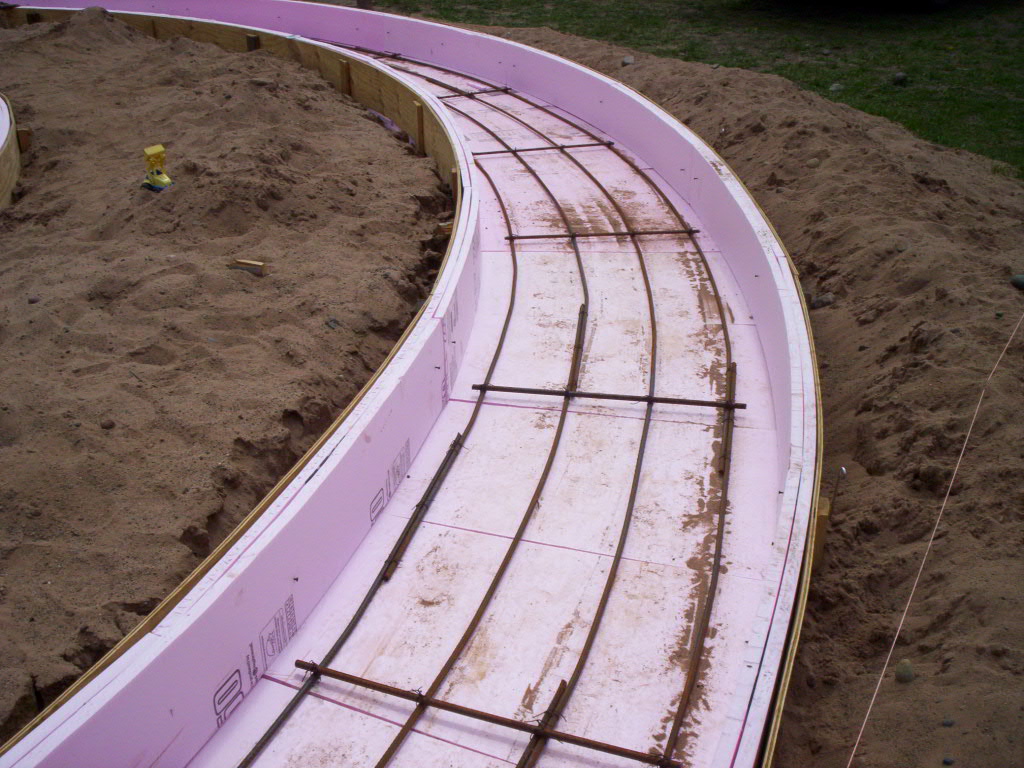
The outer footing of the ring beam.

My Dad and I striking off the outer footing. This was in the first weekend of May.
The day we poured went really well besides the fact that we didn't order quite enough cement, we were about three wheelbarrows short. Luckily, they could send out another truck ASAP.

Everything has been poured and striked off. It took us (My Dad, Brother-in-law, Annie, Daniel and I) about six hours to do.
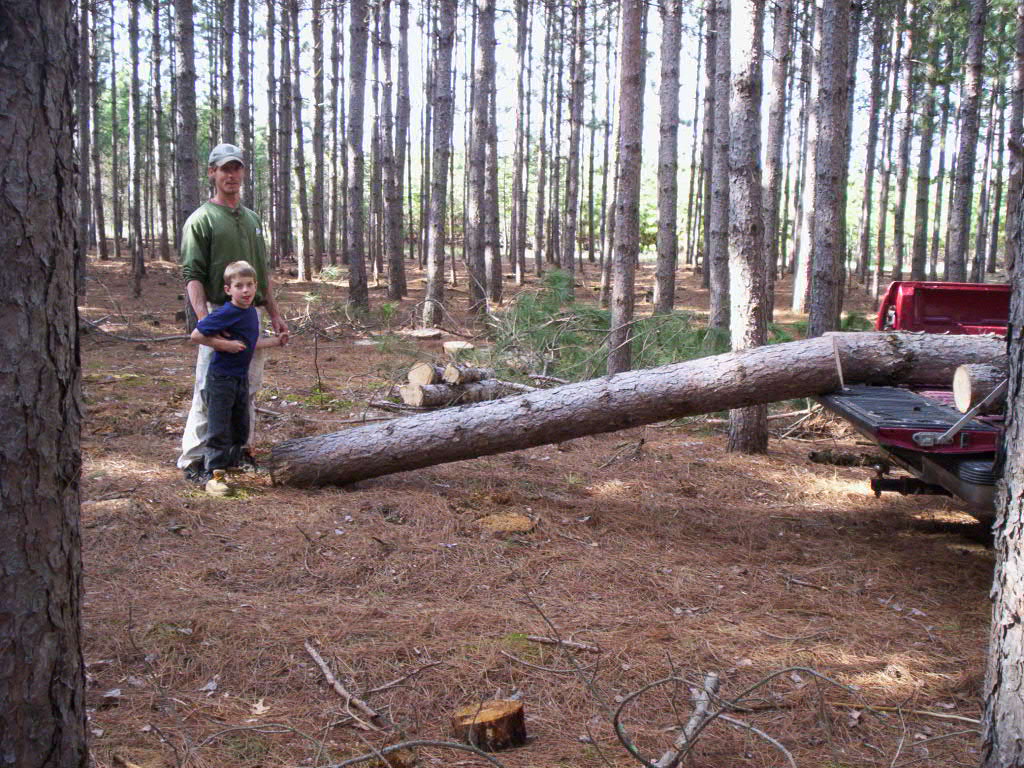
Daniel and I are loading up some red pine logs into the back of my pick-up. I cut those logs out of the red plantation that is behind my parent's house.
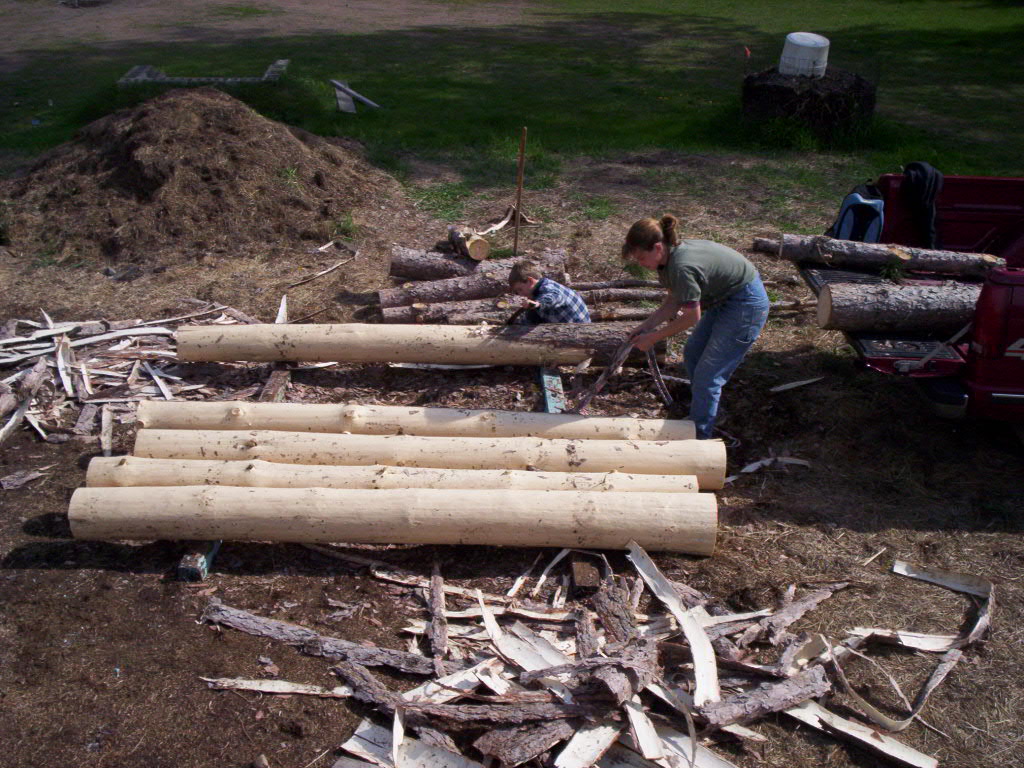
Annie and Daniel peeling the logs we harvested. These logs are being used for the inner posts of the post and beam framework.
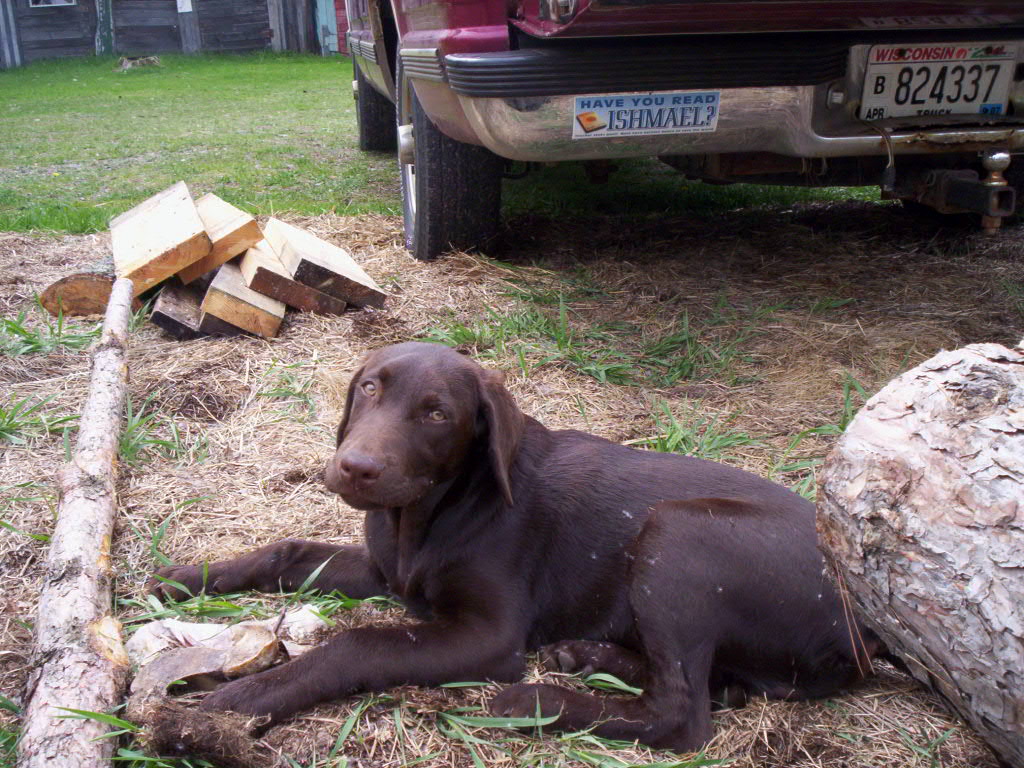
Buck watching over the process of peeling logs.
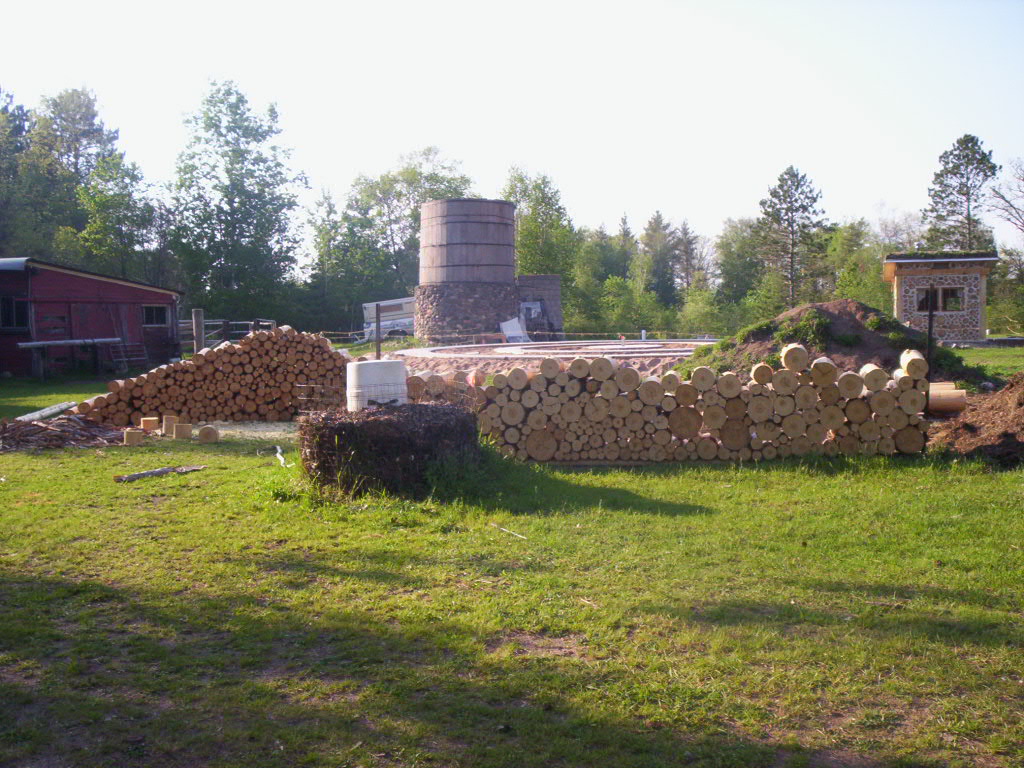
Some of the red pine logs cut and peeled.
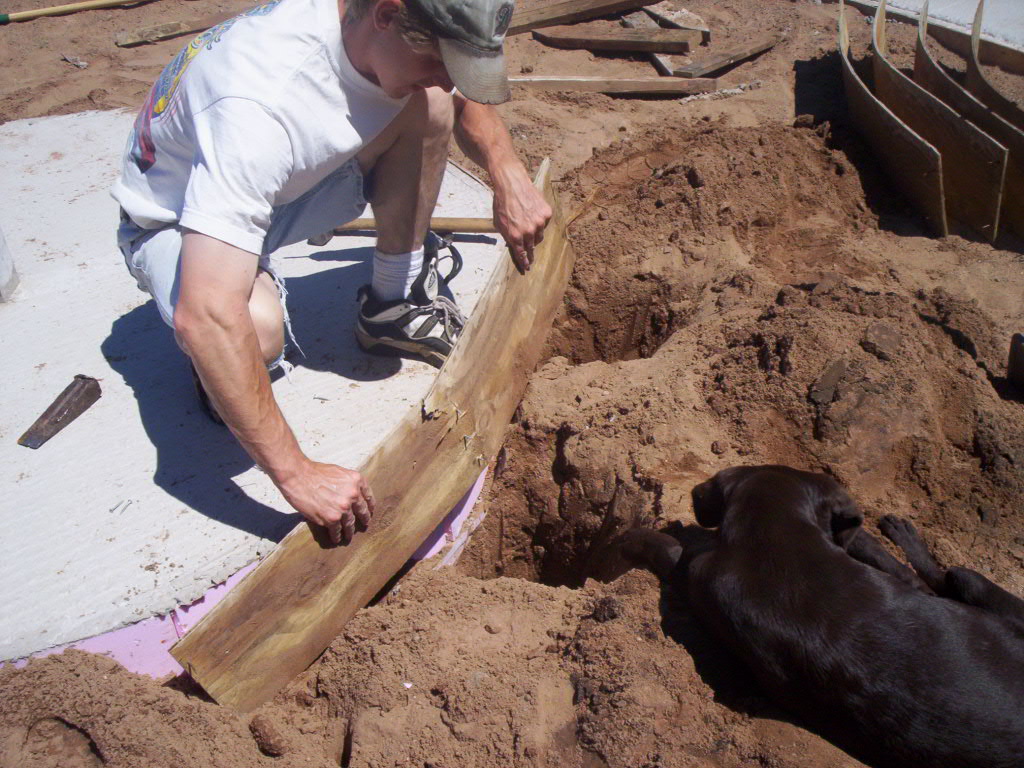
The 3/8" plywood form boards have serve their purpose and are ready to come off.
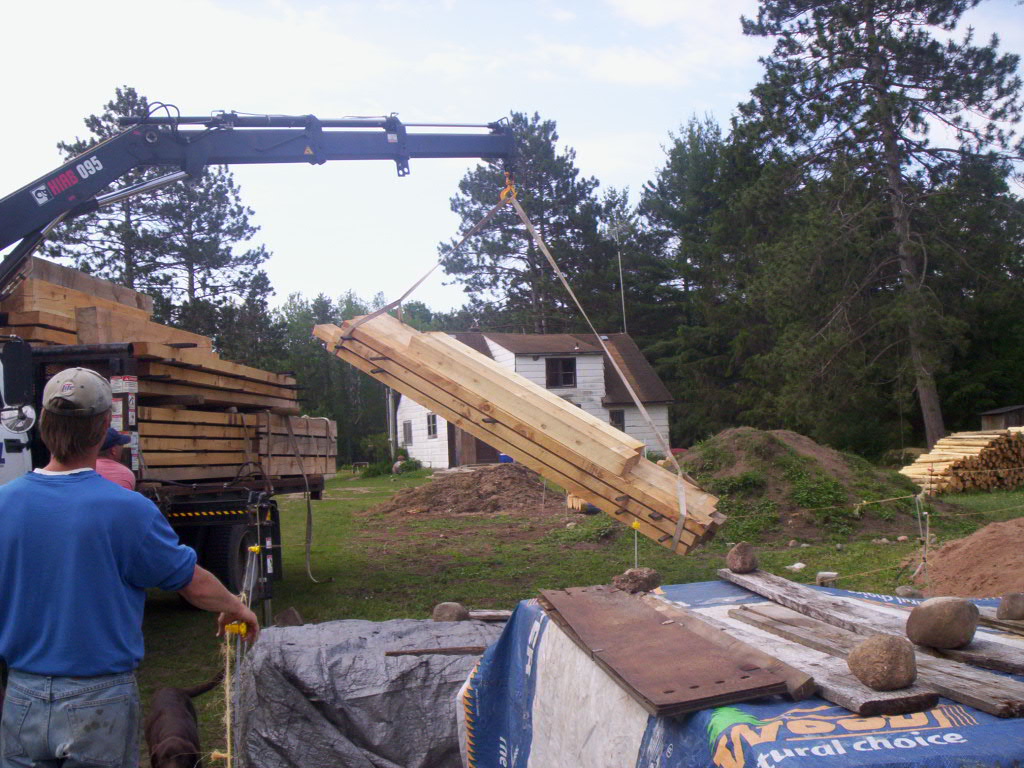
The timbers for the post and beam framework we had sawed at a local sawmill.
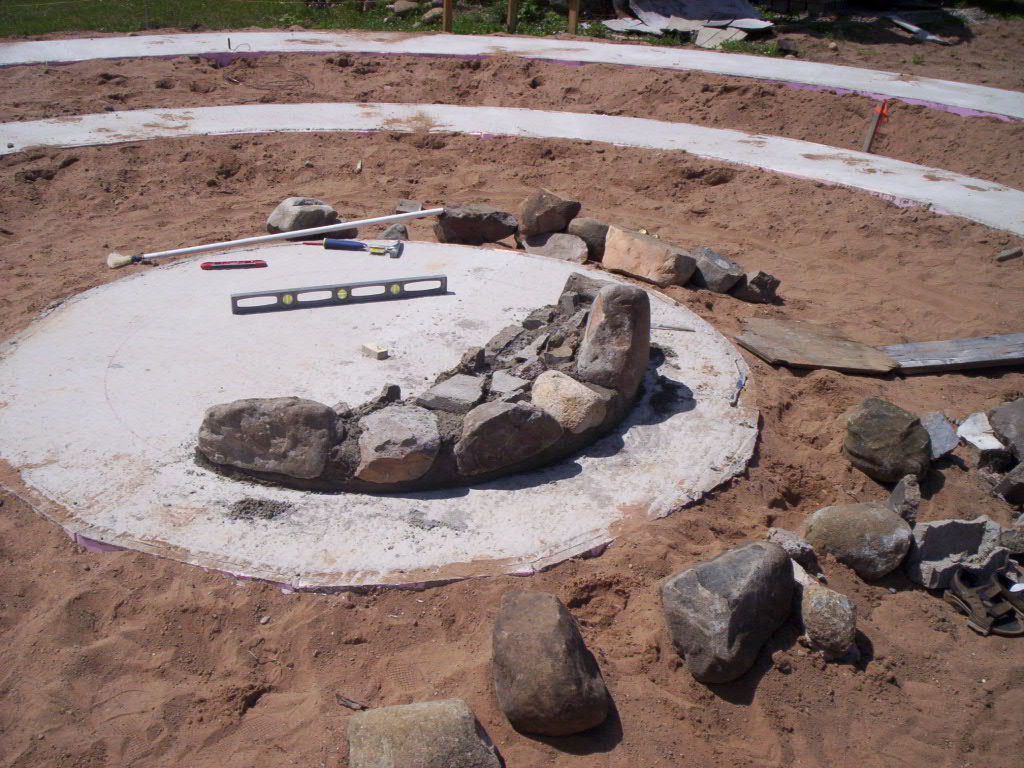
The masonry stove was started about the third week of June.
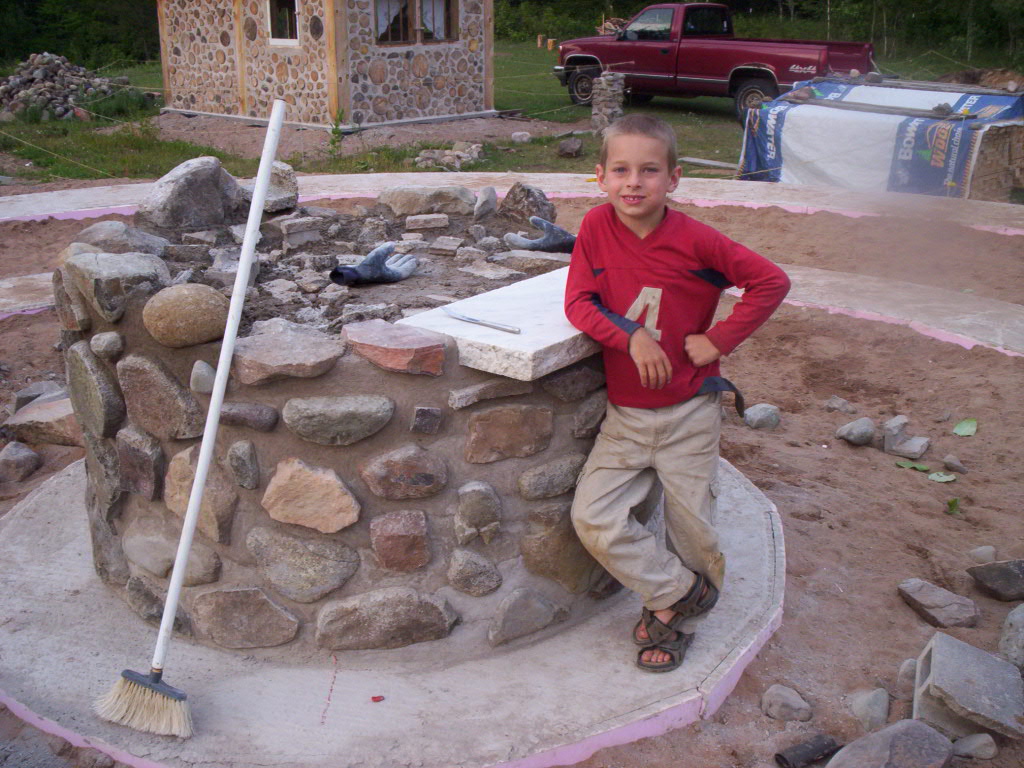
The masonry stove a few days later.

The firebox being built. We used refractory cement to bond the bricks together on the sidewalls.

The firebox with the face plate and wooden arch added to it.
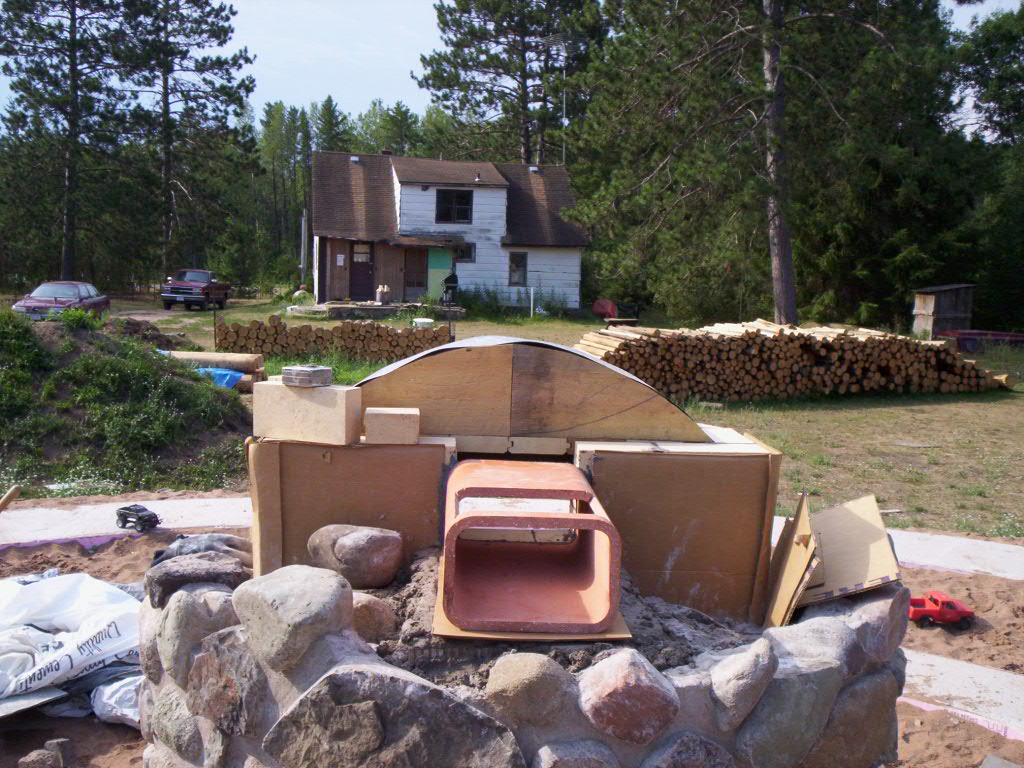
The start of the first of three horizontal runs of 8"x12" flue that will run through the masonry stove.
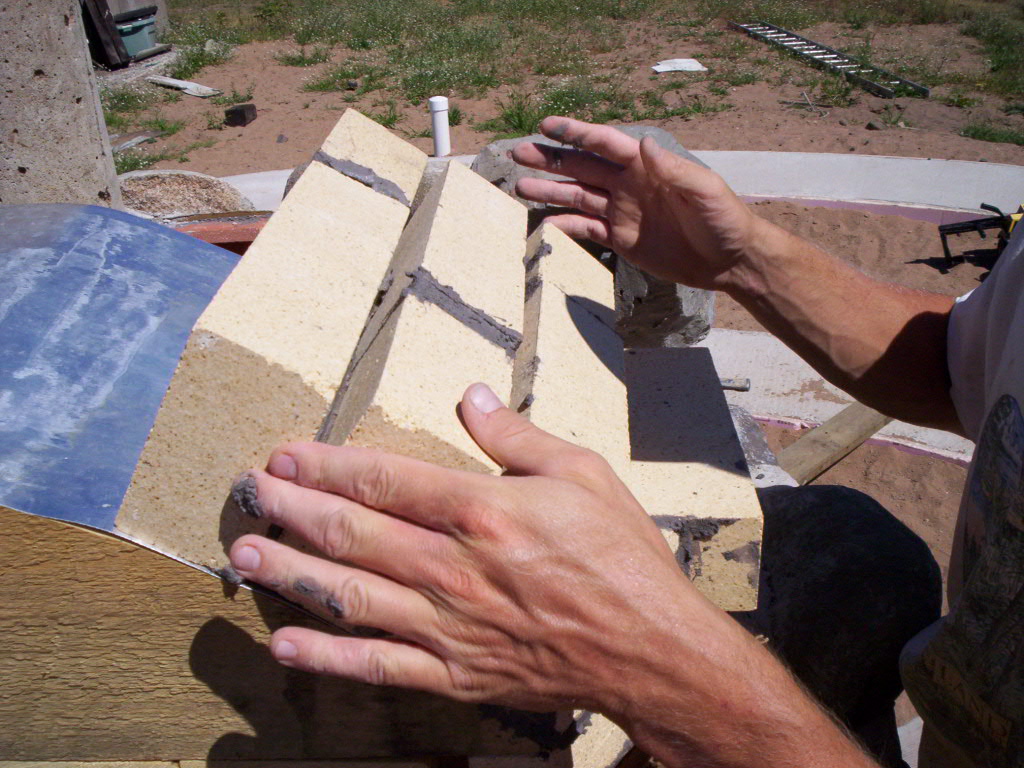
Buttering and laying the bricks across the wooden arch.

The bricks have all been laid to complete the firebox. Also a form has been set to support the rocks that will create the arch.
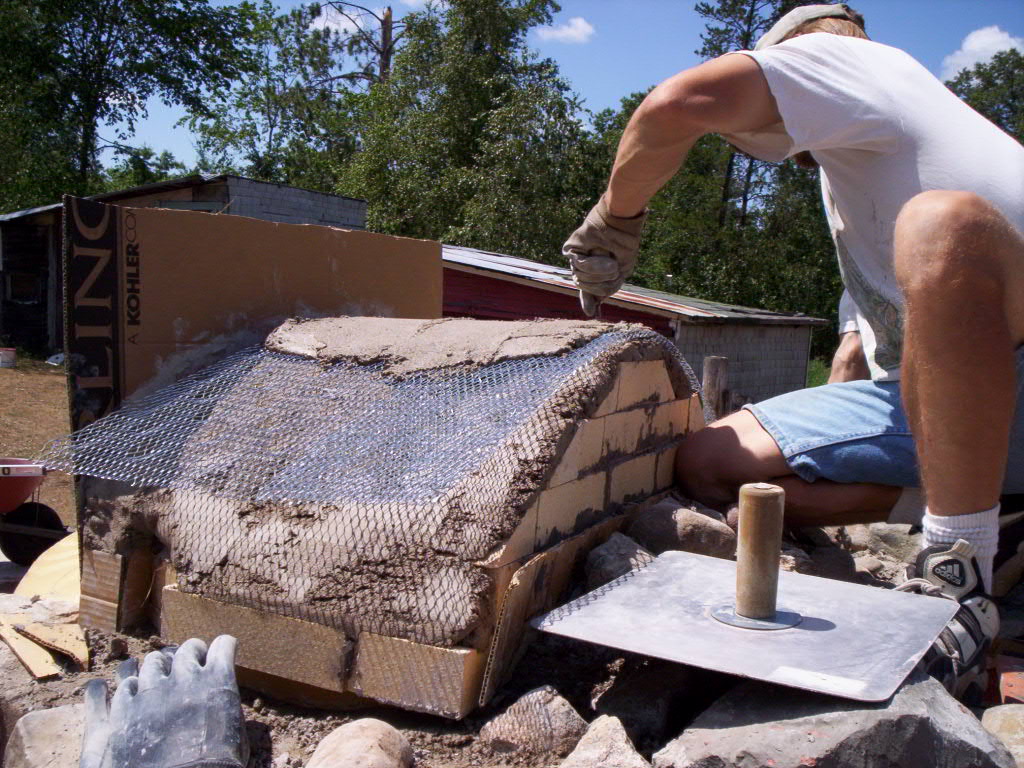
Laying the mortar cap over the arch of the firebox.

The arch stones have been carefully picked out and set above the arch form.
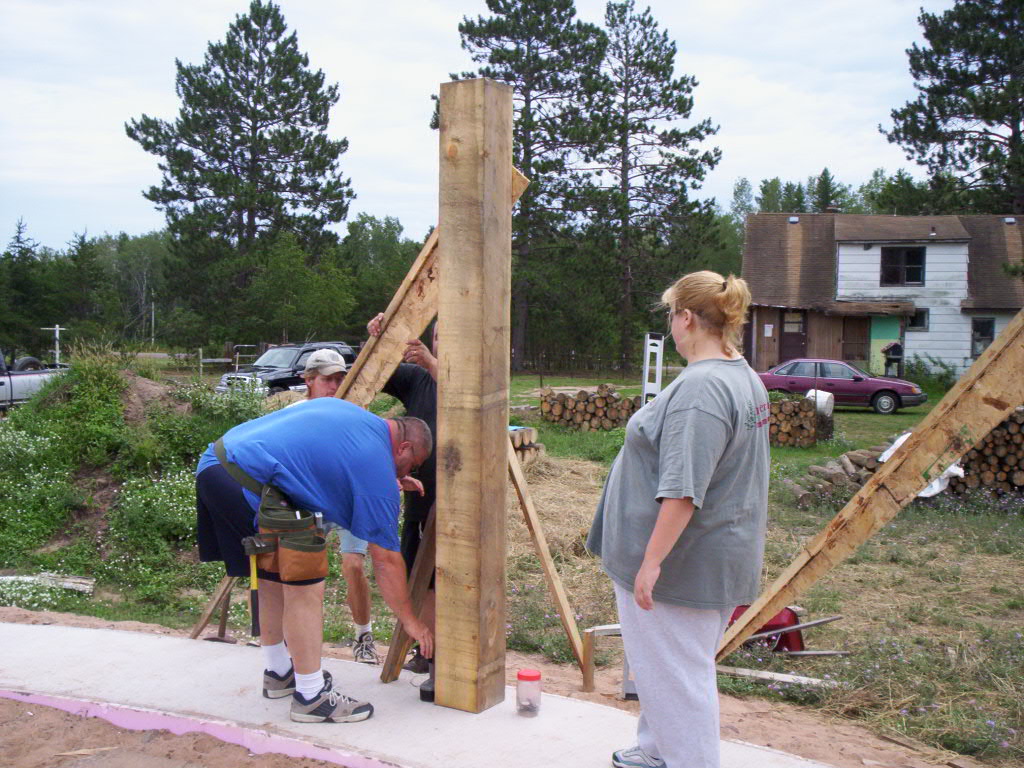
The posts for the post and beam framework are starting to go up.
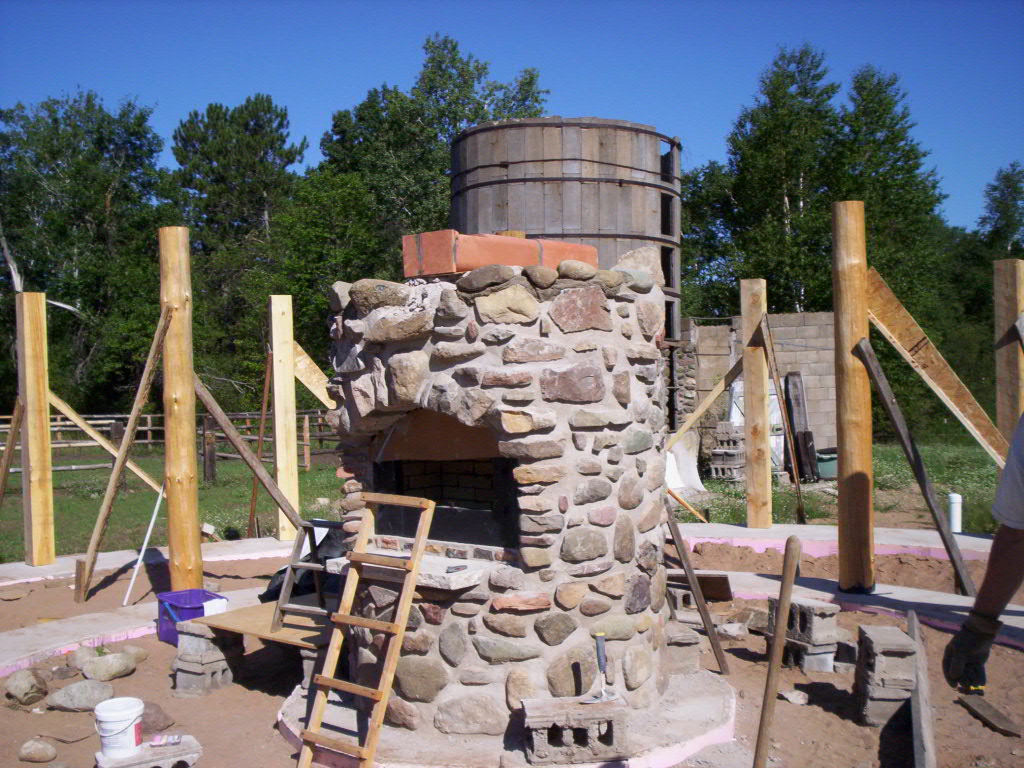
A horizontal run of flue has been completed.
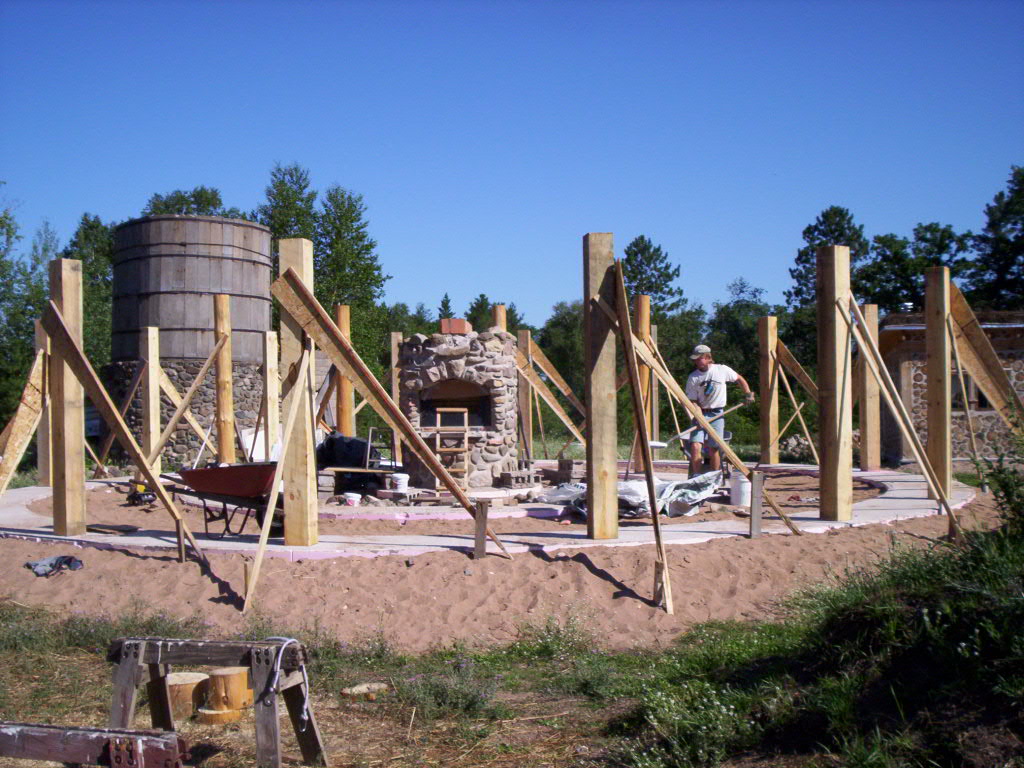
We have a good start on putting up the posts on the inner ring beam.

The heavy 8" x 12" girders are being put up on the posts. This was the hardest part of the process, the girders were pretty heavy. But we did it!

The outer girders on the outer ring beam have been completed.

Well...atleast I know it can hold me...:-)
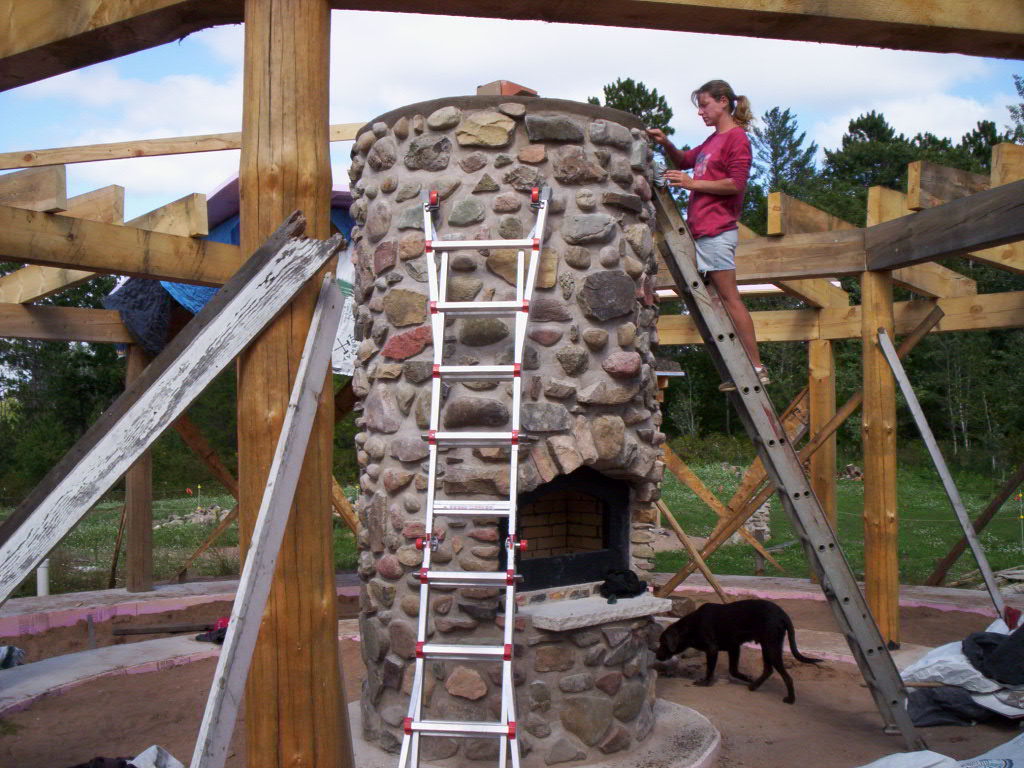
Annie is smoothing out the strong 3" portland cement cap for the rafters to sit on.

The 4" x 12" rafters are being set on the masonry stove.
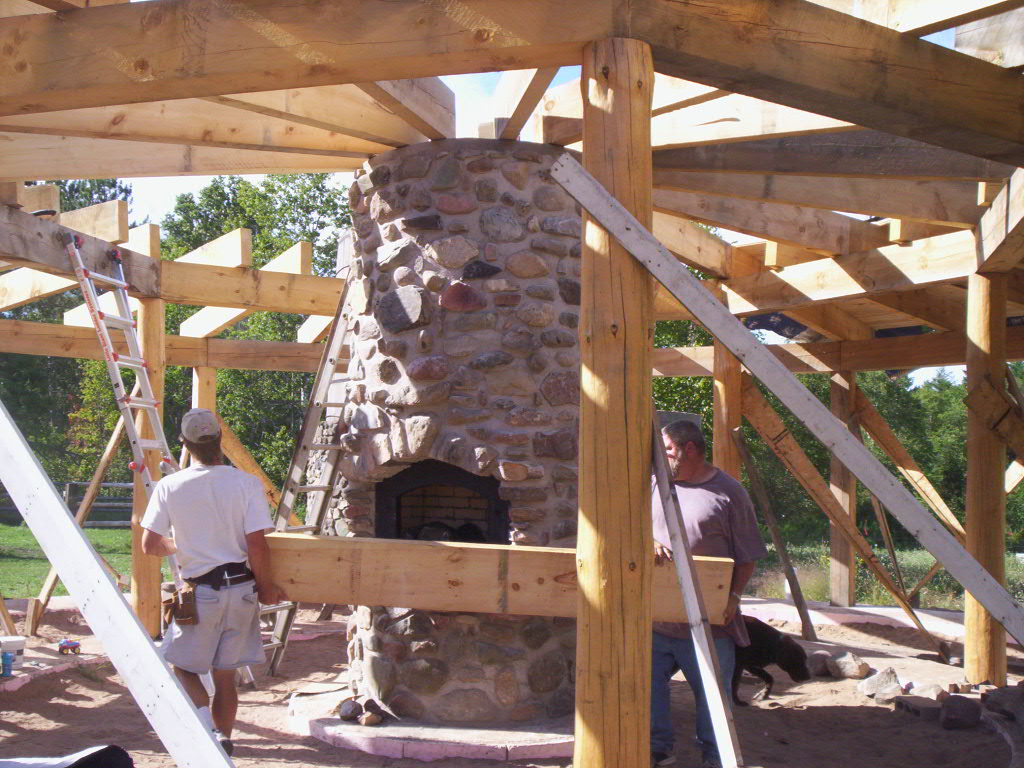
My dad and I carrying a rafter over to the ladders.

Most of the 2' X 6" roof decking has been put on. Annie is working on the 3' cylinder part of the masonry stove that will come up through the rafters. The form is made out of aluminum printing plates.
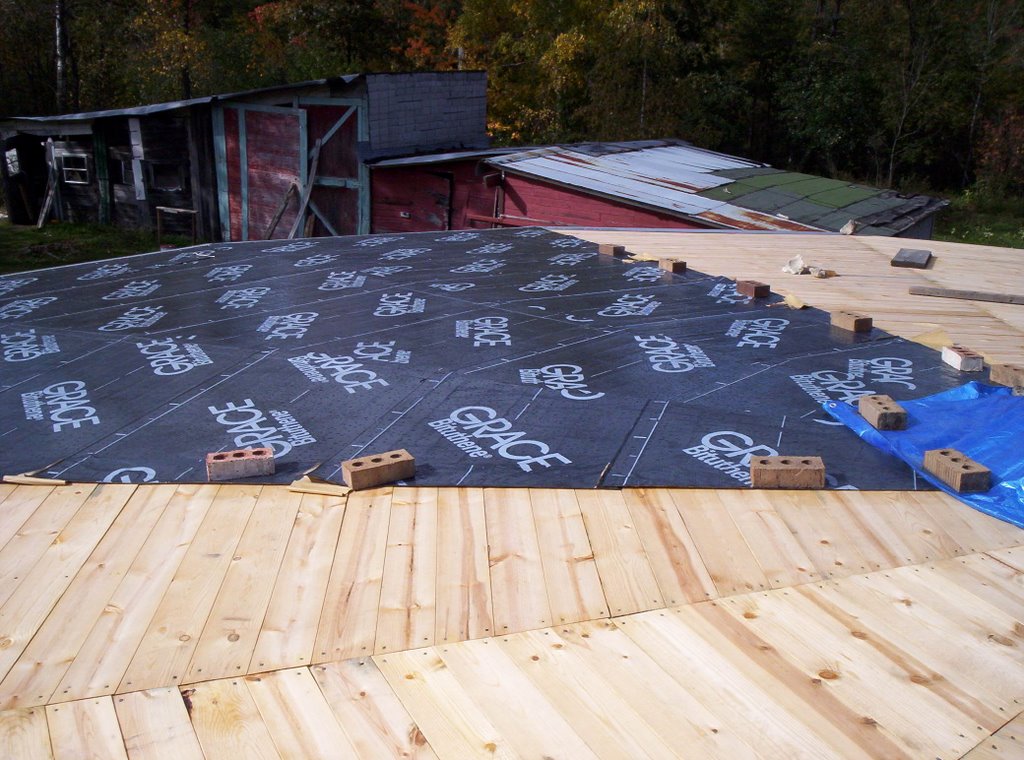
We've started putting on the waterproofing membrane for the earth roof.
energy efficiency Alternative Building Architecture
Thursday, March 16, 2006
We Respond Back.
This week Annie and I responded to the two letters that were related to my original article "Time is Precious" in our local newspaper. I'll post the letters we wrote below. And, this week, there was another response by someone in the community that I'll be posting when I get some time.
Here is my letter.
Learning
This letter is a follow-up to the letters by Brad Talbert and Dan Schullo in last week’s paper.
First of all, I’d like to make clear that my intentions of writing “Time is Precious” in a previous Letter to the Editor was not to make students who are content with the schooling system feel bad. If the system is working for them, that is great! Stick with it. Although, based on my personal experience, I know a lot of people who hated it. And this is all right, too. But usually the people who hate it are made to feel like there is something wrong with feeling that way.
And I think those who openly admit they hate the process of schooling need to be liberated from it. And why should not taxpayers, teachers, and administrators facilitate this? But instead the current trend seems to be more laws and rules, psychological labels and medications, hidden cameras and police on campus, all to make students adhere to the system.
The problem is not with certain individuals. The very fact that grades exist within the system is an explicit acknowledgement that what students are doing is not sufficiently rewarding enough. (The same holds true for wages). This external reward system exists mainly to entice them into doing the work. Usually, if someone is doing what he or she loves to do, the process is rewarding enough internally to not need a grade or a wage.
Lastly, why do not teachers and administrators sit down with the students and ask them what they want to learn? Should not the teachers and administration be there to facilitate what the students are passionate to learn about? Or does this disrupt the interpersonal politics of the system too much to do so?
As it stands now, the state, the administration, and the teachers tell the students what they need to learn. They are the authority on what knowledge needs to be presented. And this is supposed to teach children, as Dan Schullo puts it, to “learn perseverance, to set goals, and practice competition”? But these learning points lead to, as author Arthur Evans put it so well, “Modern schools and universities push students into habits of depersonalized learning, alienation from nature and sexuality, obedience to hierarchy, fear of authority, self-objectification, and chilling competiveness. These character traits are the essence of the twisted personality-type of modern industrialism. They are precisely the character traits needed to maintain a social system that is utterly out of touch with nature, sexuality, and real human needs.”
As it stands now I would put my money on the students knowing what is important for them to learn, not the state, not the administration, not the teachers. Learning starts from the bottom up.
And here is Annie's letter.
Reality
This letter is in response to the “Educational Reform” and “Stereotyping” letters in the last issue. Bradley Talbert wrote in his letter “…there are many students who enjoy going to school…we are proud of the education we receive”. All students receiving an education should feel the same way; unfortunately most do not.
I am a 1996 graduate of Spooner High School. I was a good student too and even believed that I enjoyed going there. In truth, I hated being up before 6:00am every day and not having time to do the things that mattered to me. I hated being rushed through my life. Recently I came across a real life opportunity to use geometry only to find that I couldn’t remember it even though I had received an A in the class. Like most things I learned in school it was all committed to short-term memory only to be kept until test time was over. It is in this that I find most of my disappointment with the current school system. With the amount of time spent there I should remember SO much. Instead, the deeper lessons learned had nothing to do with education. But we, as students, were not allowed to understand the banality of this because to do so would have uncovered the lie that is so ingrained in this educational system. The lie is that the school system is set up the way it is to give us better education. It is not. Its purpose is to keep young adults away from meaningful, decent paying jobs as long as possible. Before WWI it was common for young people to end their schooling around 8th grade. Some did continue, but not a lot. What do you suppose would happen now if millions of young people joined the workforce after 8th grade? The jobless rate would go through the roof. With the limited number of jobs available now, who do you suppose would be working? How many gainfully employed adults would be willing to give up their jobs to these young people? Not too many. So then, the educational system’s job is to keep young people out of the workforce as long as possible, not necessarily to give them a better education. It doesn’t always appear this way though. In fact the system goes through quite a lot to make it appear that they are trying to help these young adults become better educated so they have a chance to get better jobs. The promised is that once out of high school and college we will receive high paying jobs because we have a degree! But out on our own we find that even a degree doesn’t always help. Too many people, who have degrees, work below their qualifications. The degree didn’t help. Why?! In reality, adults who have worked their entire lives to get where they are aren’t going to give up their higher positions to high school and college graduates. Neither would they appreciate the younger graduate ascending to the higher positions without having to “climb the ladder”. Therefore no matter how well educated these young people are “supposed to be” they will still have to start at the bottom.
We cannot blame the teachers for this; we must blame the system. The teachers would love to awaken young minds but the system, from within which they must work, frustrates that desire by insisting that all minds must be opened on a certain schedule, by the same techniques, and all at the same time. The students learn that the curriculum takes precedence over their own learning desires. Some learn this quickly and adapt, some learn this slowly and painfully.
The solution is that we must all recognize this. Once we do we can change it, because it will only continue for as long as we perpetuate it. This does not mean that there should be no education, only that there are different ways to teach. Understanding that there is more to learning than tests, memorization and authority. All children desire to learn; it is the system that destroys the desire.
The thinking behind our letters was strongly influenced by My Ishmael, by Daniel Quinn and Walking on Water, by Derrick Jensen.
Ishmael Unschooling Northwest Wisconsin Education
Thursday, March 09, 2006
Responses to my Letter to the Editor
My letter to the editor last week provoked two responses. I wonder if anyone who hates school and percieves the schooling system for what it is will write in? I hope so.
Here are the two responses. And if anyone who reads this wants to respond and publish it in my local newspaper I will send your letter to the editor.
Stereotyping
This letter is written in regards to an article in the Reader Opinion last week titled “Time is Precious.”
I am a sophomore currently enrolled in Spooner High School. When I read this article, it made me sick to think that this is the way certain members in our community support students and school in general.
I disagree with the idea that we students do not want to be in school.
I think that there are many students who enjoy going to school. Our school may not be the best, but we are proud of the education we receive. We are working toward careers that we will be happy doing for a lifetime.
I do not think that it is right to stereotype us saying we are bored with education.
Maybe when you were in high school you should have taken advantage of what was offered instead of spending your time wishing that you were not there. I can name many other students who are enjoying learning and looking forward to a career that they will thoroughly enjoy.
Cutting budgets does not help a school. It makes the feeling of dislike towards a school only grow stronger. Of course there are going to be students who do not want to be there, but there is also a great number of students who like being there.
Letters like yours make us, as students, feel like we are not appreciated in the community. When the hard work we do is not appreciated, what kind of result do you expect from us?
We need more people who are here to help us, not look down on what we are doing.
Bradley Talbert
Trego
------------------------------------------------------------------------------------
Education reform
I find it very easy to agree with Curt Hubatch’s thoughts [Reader Opinion, “Time is Precious,” March 2]. He wants to enlighten us by pointing out that our society has unmotivated workers and students. It is easy to be a guru like author Daniel Quinn in his book Ishmael when your goal is to point out the problem with society or the institutions within society. The difficult task is to provide solutions.
As one of the teachers in Spooner High School, I often wonder why we beat our heads against the wall trying to convince kids that education will somehow benefit them in their future. The public education provides opportunities to learn perseverance, to set goals, and practice competition – all things that we needed to establish an entrepreneurial spirit that makes the United States a great place to live.
Utopia is a dream all humans have had since early humans were knocking rocks together, but thank goodness they kept knocking those rocks together because the result is they survived and made it.
Yes, our public schools have problems, but the education system is a product of societal needs and wants. If society values monetary wealth (as Hubatch alluded to in his letter – $5 million in the bank) then society sets up rules and guidelines to follow in order to achieve that.
Aside from winning the lottery, how is the goal of achieving a comfortable bank account possible without education? With school funding constantly being cut, perhaps society is making the educational reform that Hubatch alluded to.
Reforming education is not the solution to the problem of having unhappy citizens; reforming society is the solution that will eventually lead to the reform of education.
I look forward to Hubatch’s next letter to the editor where he enlightens us with solutions to the problem.
In the mean time, I will continue working on the front line with my fellow teachers in helping students deal with the society they live in and find their place within it
Dan Schullo
Spooner
Ishmael Unschooling Northwest Wisconsin Education
Monday, February 27, 2006
Time is Precious
I debated whether or not I should've sent the below letter off to the editor of our local newspaper. I was afraid that it sounded to radical, or to impractical. I mean come on, kids have to go to school, right? Could you imagine what the world would be like without schools? Children don't really know whats best for them. We do!
Well, I got beyond those thoughts and sent it off anyway. I thought about some of the great writing I've come across questioning and criticizing our systems of schooling. I looked back on my own experience of 13 years of schooling. I hated it. I would've rather been outside. And I've read a lot of good authors that've had similar things to say. Like: Jon Taylor Gatto, Daniel Quinn, Derrick Jensen and Carl Rogers. It's nice to know that I'm not the only person that hated my schooling experience.
Here is the letter I sent:
Time is Precious
This letter is in part response to last weeks article titled, “Spooner Schools must cut-again.” Deep down inside I was glad to see the district has to cut its budget again. The less money that people have to pay for a system that doesn’t benefit the well-being of each and every child the better. And I want to be clear that I’m not criticizing the employees of the system but the system itself.
I bet if we asked all of the students who attend Spooner Schools if they wanted to be there an overwhelming majority of them would say NO. This is sad but true. And that is one the primary reasons the system exists; to condition our children into spending the precious time they’ve been gifted as human beings into doing things they don’t want to do. After all, we only have so much time before we die. And we’re forcing our children to spend their time watching the clock (The best piece of technology in the classroom) wishing away the hours of their life waiting for the bell to ring. Wishing away your time is like cutting off the fingers on your hand, once gone you never get either of them back.
And this conditioning very effectively carries over into our adult lives. Try asking people on the job if they really want to be there. Again, I bet the majority would say no. Essentially, we live in a culture where the majority of its members spend the majority of their time wishing they were doing what they wanted to do. This is a crime. Judging by the high rates of depression, suicide, alcoholism, rape, child abuse and violence, spending our time this way just isn’t healthy. I might add the rates of all these aren’t declining.
If you’ve read this far ask yourself, how would you spend the majority of your time if you had 5 million dollars in the bank? Are you living out the dreams you had as a child? Or do you find yourself wishing the hours of your life away? These are all important questions to ask ourselves as our children spend most of their waking hours within the confines of a block building learning what they’re SUPPOSE to learn instead of what they want to learn.
“We begin with the children. It is imperative to catch them in time. Without the most thorough and rapid brainwashing their dirty minds would see through our dirty tricks. Children are not yet fools, but yet we shall turn them into imbeciles like ourselves, with high I.Q.s if possible.” Dr. R.D Laing
Ishmael Education Unschooling Northern Wisconsin
Friday, February 17, 2006
Out to Find a Tracking Stick.
It's almost noon here in northwest Wisconsin and it is Five degrees below zero. It doesn't look like it is going to get much above zero today. The sky is clear blue and there is a strong wind blowing out of the northwest. Despite the frigid temperatures, I did make it out to my sit spot to say my Thanksgiving Address and do some wandering in my study area. I had intended to visit my sit spot no matter what, but what really fired me up to get out there this morning was this great story by Josh Fecteau about his encounter with a Fischer near his study area. Josh's story just goes to show that you just never know what gift will present itself while your out poking around in the woods.
This morning, I was in search of a sapling to make a tracking stick. So, I strapped on my snowshoes, grabbed my hatchet, bundled up and headed for a clump of elm trees that were blown over just to the northeast of my study area. I'd say it took me about a half-n-hour to get over to the clump, when it normally only takes five to ten minutes at normal walk. One of the reasons why it took a little longer than intended was that I found an impression in the snow. The impression, to me, looked like a bird with its wings out stretched had landed there then flew away. And lying in the middle of the impression was a gray colored breast feather and some scat. There were no other tracks around this impression. Nearby there was two dead trees with the tops blown out of them. Perhaps the creature that made this impression and left the feather was perched in one of them? Maybe it was after a creature underneath the snow? A vole? Shrew? Mouse? You can see why it took me a little longer to get over to the elm trees.
I never did find the sapling to make my tracking stick. And I still haven't figured out what made the "flying saucer" impression in the snow. But I hope to someday to solve mystery.
#
I just finished Case Files of the Tracker, by Tom Brown Jr. I've read a lot of Tom's work and really like it. His work is one of the reasons why I'm taking the Kamana Program. I was actually first introduced to the tracker by my Chemistry teacher as a junior in high school. Wow! That was fifteen years ago! How I wish I would have headed out to the Tracker School when I was in my late teens or early twenties. Oh well, hind sight is 20/20.
Anyway, I highly recommend picking up Case Files. There is a lot to learn in that book.
#
I posted this quote over at IshCon. I really like it.
"One final paragraph of advice: Do not burn yourselves out. Be as I am – a reluctant enthusiast…a part time crusader, a half-hearted fanatic. Save the other half of yourselves and your lives for pleasure and adventure. It is not enough to fight for the land; it is even more important to enjoy it. While you can. While it’s still here. So get out there and hunt and fish and mess around with your friends, ramble out yonder and explore the forests, encounter the grizz, climb the mountains, bag the peaks, run the rivers, breathe deep of that yet sweet and lucid air, sit quietly for a while and contemplate the precious stillness, that lovely, mysterious and awesome space. Enjoy yourselves, keep your brain in your head and your head firmly attached to the body, the body active and alive, and I promise you this much: I promise you this one sweet victory over our enemies, over those desk-bound people with their hearts in a safe deposit box and their eyes hypnotized by desk calculators. I promise you this: you will outlive the bastards." Ed Abbey
Animal tracking Wisconsin Naturalist Northern Wisconsin
Subscribe to:
Posts (Atom)