Monday, February 26, 2007

WildeRix: Another Changed Mind

I just ran across this new Quinn inspired blog.

From WildeRix: Several years ago, while waiting tables in New York City, a friend turned me on to the writings of Daniel Quinn. If you have ever read any of his works, I’m sure you’ll understand when I say that it completely changed my life. That is no hyperbole. From that point on, I had to rethink everything. I began to realize that everything in the world comes from the earth and that all life comes from the sun. It reshaped not only my view on civilization, but it made me rethink my faith as well.


Ever since reading Ishmael I have always found hope in reading stories like these. It's just one more person who sees the culture for what it is, a prison. I just wonder how many people are out there with changed minds that we don't read about.

Sunday, February 25, 2007

Response to a Letter to the Editor of Mine

Here is a response to a letter I wrote to my local newspaper about a month ago.

It's really interesting how peoples reactions differ. A few weeks ago someone actually dug up my phone number and called to say that he felt the letter was really amazing. He mentioned as a retired social studies teacher he would've talked about things like this in his class. I forgot to mention that it was inspired by Ishmael. I think I'll call him this morning and let him know.

Sorry for you

I recently read the Jan. 4, Reader Opinion in the Spooner Advocate on “Myth Making.”

I am saddened by the hopelessness that must reside in the home of the writer. The bleak outlook of our past, present and future has got me wondering, “Why would anyone want to get up in the morning?” and “Where is the hope and purpose in the life you describe?”

But, before we flush all of our hope, maybe we should take a little closer look at some of the writer’s ideas. We have to remember that ideas have consequences, and bad ideas have bad consequences.

Let us look at Darwin’s rather flawed theory of evolution. In the letter, that theory seems to play out a rather pivotal role.

First off, evolution as it is stated is a theory, not fact as the letter’s author would have us believe.

Secondly, I have yet to see complete fossil support for Darwin’s Tree of Life.

Thirdly, chronology or the aging of time periods has not been proven as an effective way of tracing back man’s advancement through the ages.

And fourthly, it is my understanding that the earth’s age itself is another problem to those who swear allegiance to evolution. There are many different dates floating around. Henry Whipple had pointed out that on the average, the “age” of the Earth has been doubling every 15 years for the past three centuries. (Harold Slusher, Critique of Radiometric Dating). Apparently evolutionists need more time to make their theory work.

We could go on and on with the disproving of Darwin’s theory of evolution, but I find some other rather terrifying statements in the letter. Let me quote the author, “We really think that we can grow our population without limits.” What would the author do to control the population? What people or group of people (age, handicap, ethnicity, or religion, etc.) would the writer start with to control population, and how would he exact that control on the whole world? A similar issue like this was addressed in Europe in the 1940s, was it not? Be careful, for those who do not know history are destined to repeat it.

How about these statements of his: “And we really think that we can get away with hunting down our biological competitors, destroying their food or denying access to their food. We act like rebels.”

Remember bad ideas have bad consequences. So let’s follow his idea through. If I am at the top of the food chain because I evolved there, then does not survival of the fittest take precedence?

Earlier in the letter the writer referred to Hell as a mythical place, but how can I be a rebel if I am not accountable nor can I be punished because I am the highest evolved form? My desire reigns supreme.I would hope (no pun intended) that the writer would reconsider the mythical evolution and honestly weigh the facts from the fiction. It is important to hand down the truth and not a myth to the next generation.

May the author find the hope he seeks.

Saturday, February 24, 2007

Support our Troops?

Where I live you see a lot of people with the yellow ribbons on the back of there cars that read, Support our Troops. I've always understood this statement as Support our War. And most of the time, whenever I see a car sporting the yellow ribbon, I can't help but think about how horrible war really is. I always wonder if the person that stuck the ribbon on their car is thinking about this too. Things like: torture, bombings, rapes, Post Traumatice Stress Syndrome, death, murder, prison camps, and so on. It's just crazy.

Back to the yellow ribbons. Yesterday I ran across a really good explanation of why statements like Support our Troops are so deceptive. They're meaningless.

"The point of public relations slogans like 'Support our troops' is that they don't mean anything. That's the whole point of good propaganda. You want to create a slogan that nobody's going to be against, and everybody's going to be for. Nobody knows what it means, because it doesn't mean anything. Its crucial value is that it diverts your attention from a question that does mean something: Do you support our policy? That's the one you're not allowed to talk about." - Noam Chomsky -

Friday, February 23, 2007

The Role of Government

In responding to a post over at IshThink.org, I dug up these quotes by Adam Smith, John Locke and James Madison about the role of government in our lives. They've always stuck with me since I first read them.

When they were laying out the Federal Constitution James Madison emphatically argued that the goal of the American political system was "to protect the minority of the opulent against the majority." The Debates in the Several State Conventions on the Adoption of the Federal Constitution, 1:449-450

Or to quote John Locke out of the Two Treatises of Government, "Government has no other end but the preservation of property."Second Treatise, Sections 138-140

And lastly to quote the godfather of modern economics, Adam Smith, "Civil government...is in reality instituted for the defense of the rich against the poor, of those who have some property against those who have none at all." An Inquiry into the Nature and the Wealth of Nations, 413

Tuesday, February 20, 2007

Advice

I really hate the effects schooling has on most people. And if I had the chance to put together a small booklet or pamphlet explaining why school is what it is I 'd include this advice Ran Prieur gave to a 19 year old college freshman on Feb. 20th.

I really like this part: If you're not going into debt, college isn't so bad. The main thing you're learning is not the content of the classes, but how to think and act like an "educated" person. For that reason, college is much more valuable for lower class people than for higher class people who already know how to act like that.


Thursday, February 15, 2007

Evil

In A Language Older than Words, Derrick Jensen said something like hell is when one forgets that all life is interdependent. Welcome to our culture. Anyway, Ran Prieur had what I thought was a really good definition of what evil is on his blog yesterday.

My definition of evil is a compulsive withdrawal or reversal of empathy. Empathy is simply the extension of the sense of "self." The root of evil is in the original splitting of the One Mind into many perspectives, which, I'm guessing, was done to create free will and surprise. So, when you have the option to move back toward the One, to expand your sense of "self" from, say, your material wealth to your body, or from your body to the bodies and feelings of the people around you, and you refuse, and that refusal becomes compulsive, that's what we call evil.

Wednesday, February 14, 2007

Death

Lately I've been thinking about death. I think it is safe to say that I've feared death for most of my life. And I also think it is safe to say that the reason this culture has a death urge is because of its overall fear of death.

This morning I dug up a quote by Ed Abbey talking about the fear of death. I'm going to type it out here so that I have it for future reference and because its good.

From Pg. 41 out of Walking It Off, by Doug Peacock:

"If your life has been wasted, then naturally you're going to cling like a drowning man to whatever kind of semi-life medical technolgy can offer you, and you're going to end up in a hospital with a dozen tubes sticking in your body, machines keeping your organs going. Which is the worst possible way to die. One's death should mean something. Those who fear death most are those who enjoy life least. Death is every man's final critic. To die well you must live bravely." Ed Abbey

Sunday, February 11, 2007

What a Way to Go: Life at the End of Empire

This film looks like it is going to be one of the best I've watched in a long time. You can watch the trailers HERE.

VisionQuest Pictures presents a Storkboy Film WHAT A WAY TO GO LIFE AT THE END OF EMPIREA middle class white guy comes to grips with Peak Oil, Climate Change, Mass Extinction, Population Overshoot and the demise of the American Lifestyle.

What is it doing to us as thoughtful human beings as we face the overwhelming challenges of:

• Dwindling fossil fuel reserves?
• Critically degraded ecosystems?
• A changing climate?
• An exploding global population?
• Teetering global economies?
• An unstable political climate?
• And what is it doing to the rest of the life on this planet?

Featuring interviews with Daniel Quinn, Derrick Jensen, Jerry Mander, Chellis Glendinning, Richard Heinberg, Thomas Berry, William Catton, Ran Prieur and Richard Manning, What a Way to Go will look at the current global situation and ask the most important questions of all:

• How did we get here?
• Why do we keep destroying the planet? and
• What do we truly want?
• Can we find a vision that will empower us to do what is necessary to survive, and even thrive, in the coming decades?

Tuesday, February 06, 2007

Letter to the Editor About Schooling

Last week my letter that I wrote to the editor was posted in my local newspaper. It's really tough to get in what you want to say in 300 words. I felt really constricted and frustrated writing it. I wish I had about a 3000 word limit to work with.

Death means Renewal

This letter is in response to the article about the Spooner School Citizen Action Group. What I got from the article is that we need to spend more money on a dieing school system. The students need bigger and better buildings, more teachers, smaller classroom sizes and better curriculums. But like always these prescriptions fail to do what they set out to do, and that is to “awaken” young minds. That’s what education is supposed to do. But the system has the opposite affect; it deadens the instinctual wonder and curiosity of children.

Very little of the information (except basic reading, writing and arithmetic) that students are forced to learn in their 12 to 16 years of schooling is ever retained and used throughout their lifetimes. Students know this. The most famous question when I was in school was: When am I ever going to use this information? It’s simply a waste of their time.

What our current educational model accomplishes with almost 100% efficiency is that first, it keeps children out the job market for the most part until they are 18 yrs. old, and if you go to college it can be 25 yrs old. If children were able to enter the job market at the age of 14 you would have a lot of jobless people running around instead of a consumer class spending their parent’s money. The jobs just aren’t there for this age group like they were in our highly agrarian society that existed 100 to 150 years ago. It should be noted the more urbanized and industrialized this society has become the more years of schooling has been required.

Second, graduates have little survival value outside the confines of our economy. They are forced to either get a job or starve.

Our current educational model meets the needs of our economy but doesn’t meet, and never was meant to, meet the needs of human beings; therefore it can’t and never will work. (I always have to laugh when administrators say it’s all about the students but yet they never ask the students what they want to learn.) No amount of taxpayer money spent on new buildings, educators and curriculums will ever fix this. Let the system die. With all death comes renewal!

Thursday, February 01, 2007

Kunstler Mentions Quinn

Here is James Howard Kunstler's latest article in Orion Magazine.

He actually mentions Daniel Quinn: "We have to do better. We have to start right away making those other arrangements. We have to begin the transition to some mode of living that will allow us to carry on the project of civilization—and I would argue against the notion advanced by Daniel Quinn and others that civilization itself is our enemy and should not be continued. The agenda for facing our problems squarely can, in fact, be described with some precision. We have to make other arrangements for the basic activities of everyday life."

I really don't think JHK truly understands what Daniel Quinn is saying in his work. Heres page 90 out of Beyond Civilization that clearly shows that Quinn doesn't hate civilization:
"People who dislike what I'm saying will often try to reassure themselves with the thought that I'm just someone who hates civilization and would rather live "close to nature." This will bring a smile to the face of anyone who knows me, for I'm a great lover of civilization and live happily in the heart of the fourth largest U.S. city, in easy walking distance to drugstores, supermarkets, video rental shops, art galleries, restaurants, bookstores, museums, pool halls, universities, and tattoo parlors. (And I live "close to nature" every second of every day, 365 days a year, since "nature" is something no one can escape living close to, no matter where you happen to live.)

"Or they challenge me to say how I'd like living without air conditioning, central heating, indoor plumbing, refrigerators, telephones, computers, and so on. They think I'm an apostle of poverty, though they can't point to a single word in any of my writings to support such a notion.

"I'm not a Luddite or a Unabomber. I don't regard civilization as a curse but as a blessing that people (including me) should be free to walk away from--for something better. And something better is what I'm after; and nothing less. Those who are looking for something worse definately need to consult a different book." Pg. 90

Wednesday, January 31, 2007

Inspiring Manifesto

This morning Dominic Ebacher posted this at the Wisconsin Ishmael Reader's Group. I highly recommend checking out his Manifesto. I thought it was well done.

Hello everyone here - especially curt. I've never posted to the group before, but have responded to many of the individual posts. I just wanted you all to know that I've finally done it: and that for the first time in my life I am taking solid steps to leave taker culture and just walk away. I just earned my degree a few weeks ago, and starting in March I begin my transition to a simpler life. I couldn't think of too many people that would be excited, so I thought I'd post here; thinking maybe someone would find my thoughts or experiences even a little bit encouraging.

I wrote up the bulk of my thoughts on my homepage here:

http://ebacherdom.googlepages.com/dominicebacher%27smanifesto

I would be honored if you, my fellow aspirants towards a more simple way of life would read these few words of mine, and if possible leave me some words of encouragement of your own as I set off into my new life (as so many in my life are desserting me, now that I am not conforming to the taker lifestyle as they hoped I would). It really would mean a lot to me.

Thanks again Curt for all your wisdom and involvement - at the end of the month I return to Washington. If you're looking for a great getaway (and I mean FROM IT ALL) look me up. Mention ishmael, and I'll get you everything you need, you'll always be welcome in my home and that's the way it should be.

Be well!

Dominic Ebacher


I always enjoy reading and supporting people living there own stories. In fact, I do so much of it that I rarely get a chance to write about my own personal story. Oh well, right now I'm having fun supporting and reading about others.

Monday, January 29, 2007

Endgame on YouTube

Check out this really well done video on YouTube promoting this year's film festival for Derrick Jensen's amazing book ENDGAME.

Thursday, January 25, 2007

My Letter and Cassia's Essay

I'm going to post a letter to the editor that I wrote to our local newspapers and an amazing essay by 17 year old homeschooler Cassia Scarborough.

Here is my letter to the editor. I actually had a retired school teacher that was visiting his cabin in our area call me to say that he and his neighbors really liked the letter. I really felt good about this. It's always good to here praise.

Many cultural myths dispelled
Sawyer County Record


A few weeks ago, our 7-year-old son mentioned that a fellow classmate had the good intentions of letting him know that if he didn’t believe in God he was going to hell. I smiled. I was told the same thing when I was a child.

It’s been a long time since I’ve thought about what it would be like to spend eternal life in the fires of hell. By now I thought for sure this myth wouldn’t be as popular as it once was in our children’s culture, apparently not.

This story has led me to question how cultural myths change over time. Take a look at the three dirty tricks the gods have played on us so far. First off, they didn’t put the world in the center of the universe where we would’ve liked it to be. We can thank Nicolaus Copernicus for that.

Secondly, they didn’t make us in a separate act of creation. It was arranged so we evolved from the common slime, just like spiders and centipedes have. We can thank Charles Darwin for that.

And lastly, this trick is one most of us haven’t fully realized yet. The gods made it so were not exempt from the same biological laws that govern the lives of ticks and timber wolves. And why would it be any other way?

We’re not exempt from the laws of gravity. Anyhow, we can thank Daniel Quinn for this.

Like Darwin, Copernicus and Quinn we can start to question these so-called “self evident truths” that have been handed down to us through the generations. Look at how we conduct ourselves within the biological community. We really think we can grow our population without limit. And we really think that we can get away with hunting down our biological competitors, destroying their food or denying them access to their food. We act like rebels.

There are consequences for members of the biological community who’ve made it a policy to behave like this. It’s called extinction. And the gods aren’t going to save us.


I am the King of the World
An Essay on Conquest and Consequences
by Cassia Scarborough


What if the world was made for a single person? What if, for example, it was made for you? What would you do if you knew for a fact that from the moment you were born, the world was yours. God himself had fashioned the universe so that your solar system could float in it. He made the solar system so that your sun could be in it. He made that burning coin so that it could warm the ninth rock that circled it like a befuddled moth. He made that ninth rock so that the ocean could be in it. He made the ocean so that slime and amoebas could wriggle and squirm into life. He made frogs and newts and such slimy things as those so that they could make use of dry land. He made reptiles so that they could evolve into mammals. He made mammals so that Homo Habilis could bask in what would be called Africa. He made Homo Habilis so that Homo Erectus could explore Europe and Asia. He made Homo Erectus so that they could one day become Homo Sapiens and of course Homo Sapiens came into existence solely so that you yourself, you child of fortune, you supreme being, you pinnacle of creation, you to whom the Gods have entrusted the world, so that you could be born.

If the world was made for you, then it follows obviously that it belongs to you. So, now you can kinda call yourself the ruler of the world, talk about an ego boost, eh? Imagine Leanardo DiCarprio on the helm of the Titanic, arms splayed apart, screaming, "I'm the King of the World!" Well, won't he feel silly when he hears the truth. You're not at the helm of some silly ship, you're leaning over the earth, running your fingers through your oceans, watching your seagulls swoop through your sky, running along the silken shoreline of your beaches, cackling with the insane unbelievable power rush.

Suddenly, all the old rules no longer apply. Sharing? Why should you share anything with anyone when everything and everyone was created for your benefit? Obviously trees were made so that you could have air to breath and pretty wooden furniture in your home. If you want to cut down a forest to make an army of ornate coffee mugs with intricately carved handles then you are goanna cut the fucking forest down and no one can say a thing because it's yours. And if you want a fox fur coat then the foxes are just gonna have to deal with that. And if you want sex with that attractive neighbor on Laurel St. well then, what is there to stop you?

You could make Hollywood into your own private night club. Africa could hold your huge, sprawling house of ten thousand rooms. You could have a pride of lions as your house cats and jackals as your guard dogs. The veldt could be fashioned into a nice lawn. Florida could become nothing but swimming pools and little bars that sold only your favorite drinks, as long as you got rid of those nasty alligators. School could be out, forever. Unless of course you have children of your own, in which case you could make school be twenty three hours a day, six days a week, giving you more time to enjoy your swimming pools and alcohol.

But obviously the world was not made for a single person. That would be impossible. Sorry to spoil your delusions of grandeur. Time to come back down to reality. However, what if instead, the world was made not for specific person, but a specific species? What if God created the solar system, sun, planet, ocean, amphibians, reptiles, and mammals for the sole benefit of a chosen race, a race of fortune, a race composed of supreme beings gifted with the knowledge needed to govern His realm. This species would obviously be the pinnacle of creation, the grand finale. What if the world was made for man?

"Think of the consequences of taking that as your premise. If the world was made for you, then what? ... If the world was made for us then it belongs to us and we can do what we damn well please with it... That's what's been happening here for the past ten thousand years. You've been doing what you damn well please with the world and of course you mean to go on doing what you damn well please with it because the whole damn thing belongs to you." (Ishmael, page 61)

Ishmael, the award winning novel by Daniel Quinn, posits that Humanity has taken as the premise of its culture the idea that the world was made for man. Daniel Quinn uses dialog to entrap the reader and attempts to answer the very fundamental question of how things came to be this way. How did it happen that global warming is causing huge storms, huge shifts in weather patterns, everything from droughts to floods, and no one seems to be worried? How is it that we can read about the imminent collapse of oceanic ecosystems without breaking a sweat? How did it come about that there are six billion people on the earth and overpopulation looks like it will lead somewhere nasty? How can we hear about pollution, war, starvation, the end of speciation itself without flinching? Or even if we flinch at these things, what is it that keeps us from actually stopping them? There are many reasons, but the main one is that we have all been lied to. Ishmael is an attempt to shed light on that lie, so that we as a species may just have a chance to survive its effects.

In Ishmael, the protagonist is a disillusioned writer who remains nameless. He was once an idealist, a man out to save the world that he saw slowly falling to pieces around him, but time passed and cynicism set in and by the time the story starts he has lost the dreams that used to drive him to search for something other than the life doled out to the masses. One fateful morning, our man opens his newspaper to see a strange ad in the classifieds section. It is three lines, in bold print, with an address below. The ad reads:

TEACHER SEEKS PUPIL.

MUST HAVE AN EARNEST DESIRE TO SAVE THE WORLD.

APPLY IN PERSON.

In order to assure himself that the whole affair was nothing but a hoax dreamed up by some money hungry guru spouting hymns to peace and urging people to love their neighbors, he goes to the address indicated. The place he finds doesn't look like his idea of a pseudo-guru's abode; it is a dingy office building in a run down part of town near the docks. The room that he enters is even further from what he had expected. It has only an armchair, a bookshelf, and a black glass window looking into an adjacent room. What our hero soon discovers is that the window also looks into a pair of big, black eyes. And that the eyes, when looking into his, speak. And what they say, will change not only his life, but the lives of anyone who reads Ishmael with an open mind and a an earnest desire to save the world.

The black eyes belong to Ishmael, the teacher. Ishmael is a gorilla. He and the the man meet almost everyday after that, slowly revealing the truth of how things came to be the way they are, what lies we have been told, and what happens if any one species begins to believe that the world was made for them.

In this novel, special meanings are given to certain words. When talking about a story, Ishmael makes it clear that he is talking about, "A scenario interrelating man, the world, and the gods." A story must always have a premise, as any writer can tell you. A premise is, "the question or problem that is the basic idea of a story. www.scriptsales.com/DDFundTerms.html." Finally, a culture is defined by Ishmael as, "A group of people living so as to make a story a reality."

What happens when a species takes as the premise of its story that the world was made for man? And what happens when a culture develops that is composed of people living so as to make that story a reality. It does what it wants with the world. If that species feels that it owns land, then it will claim it. If it claims it, it can do whatever it wishes with that land, and anything that used to live there just has to deal with it. So what if humans want Florida to become covered in pools and bars? It will mean that alligators will have to be killed, but what of it? We own the land known as Florida, we own the pools, the bars, and we own the alligators, they were all made for our benefit, so of course we'll do what we wish with them. If we want the Veldt to become a green, sterile lawn, then why the hell shouldn't it be one? If we want a lion for a pet, it's our right to put the great tawny cats in cages.

"...If a king comes to a city that will not meekly submit to his rule, what does he have to do?"(Ishmael, page 73) The answer is obvious enough. If the world was made for man, then it follows that man owns the world in which case man must be the ruler of the world. Another way to say this is that not only was it the god's intention to create the world for man, but it was also His intention to create man to rule over the world and the lower creatures. But as we can see, by the fact that man's rule has not been an easy one, the world refused to submit to god's plan for it. The crops that man planted, drought, insects, floods ruined. The walls that he built, the weather broke down. The orders he wrote, chance laid siege to. What does a king do when a whole world refuses his rule? He conquers it.

Now, we can articulate the premise of our culture's story better. It is, the world was made for man, and man was made to conquer and rule it. The problem with this premise is that by living so as to make it a reality, we really are conquering the world, and we are doing such a good job that if we don't stop soon, we are going to kill it. Why don't people riot in the streets when the hear about the rain forest burning, 90% of the large fish in the ocean dieing, storms that will get more deadly with each passing year, chemicals in our food and water and air that will kill us or make us glow or both. It is because they believe what they have been told.

They have been told a lie. The lie is that the world was made for man and man was made to conquer and rule it and that the price we've paid, the pollution, the destruction, the death of the only world we can survive on, was inevitable. It's what we've had to pay for indoor plumbing and microwaves. It's worth it. There was never any other option. This is what Humans were born to do, this is what we would have done no matter what, maybe we're flawed or maybe we're just stupid or evil or greedy or whatever, but no matter what, this is how things had to turn out. All this was just the price we've had to pay to fulfill our destiny.

"Would things have been this way if the world were made for jellyfish?... No, they wouldn't... Obviously not, if the world had been made for jellyfish things would have been entirely different... That's right, but it wasn't made for jellyfish, it was made for man... It's sort of a sneaky way of blaming the gods for everything. If they'd made the world for jellyfish, then none of this would have happened." (Ishmael, page 62)

The question then, is what is there left? If the story we are enacting is killing us, what can we do? Ishmael has some good news. If a whole species thought that the world was made for them, and that was the only story to enact, then we would be in trouble. Luckily for us, not all humans think the way that civilized people do. Scattered across the globe are the remains of native cultures, each one different from every other, some violent, some peaceful, all living in a way that is in harmony with the rest of the world. They are enacting a story as well, a story that does not cast them as the earth's enemies. Their story's premise can be articulated as this: man was made for the world.

What if every single plant, animal, stone and river was made for the world? What would you do if you knew for a fact that from the moment you were born, you were a part of a community. A community that relied on diversity for its survival. A community composed of other animals that were different from you, but also in some ways the same. A community in which there were laws as invisible and unbreakable as the law of gravity. What if the slime and amoebas lived, just to be alive, not as a stepping stone to some divine species? What if newts and frogs were alive simply to be newts and frogs? What if reptiles and mammals lived just for the sake of being alive in a part of a community? What if humans were just another species of animal, different, but not a pinnacle. What if there was something to come after man? What if there were lots of somethings to come after man?


This story talks about the world as if it were an apple tree. An apple tree can be said to grow apples, you could even say that an apple tree apples. Like a tree, the world grows people, or the world peoples. The apples belong to the tree that gave birth to them, they owe the tree everything. So too, the peoples belong to the earth, they owe everything to it. Just as there is no need for the apples to try to control the tree, or to conquer the tree, so there is no need for the peoples who enact this story to try to control the world, or to conquer the world. The tree gives the apples everything they need to survive, and in return, the apples hold within themselves the seeds of new trees which they will one day sow. The apples give themselves to the animals that need their flesh to survive and the animals give themselves to the soil at the tree's roots so that it may be left richer than it was before their deaths. So too, does the world care for her peoples. The world gives her peoples everything they need to survive. It feeds the lions and the zebra, waters the grass of the Veldt, sends fish to the alligator and insects to the fish, rain to one forest, fire to another, all to keep her children healthy and alive. The earth is old. The earth knows how to rule fairly. It does not need humans to rule, it needs humans to belong to it like every other animal.

"High overhead, moon and planets and stars swung in their long smooth curves. They had no eyes and they saw not; yet from the time when man's fancy first formed within him, he has imagined that they looked down upon the earth. And if so we may still imagine and if they looked down upon the earth that night, (when humanity disappeared) what did they see? Then we must say that they saw no change. Though smoke from stacks and chimneys and campfires no longer rose to dim the atmosphere, yet still smoke rose from volcanoes and from forest fires. Seen even from the moon, the planet that night must have shown only with its accustomed splendor-- no brighter, no dimmer."(Earth Abides, page 16)

The story we are telling by the way we live our lives will change. It must change. There is no alternative. "Peace will come, but whether of harmony or entropy I cannot say." (Unknown) Either humanity will kill itself, or the world will kill us, or we will redeem ourselves. If we kill ourselves, death will come in war. If the earth kills us, it will come in natural disasters. The earth will not let one species ruin eons of work. It is like a mother, it is hovering around us tapping its foot in the form of unseasonable frosts and huge storms, and it is glaring at our messy room and it is telling us that if we don't clean up after ourselves it will and if it has to clean things up we aren't goanna like how it does it. (anology by derrick jensen, i couldn't find the direct quote) In the long run, humanity's death will cause no more disturbance then the death of a fly. "Men go and come, but earth abides." (Ecclesiastes, I, 4)

"I consider myself answerable to -- responsible to -- the humans who will come after, who will inherit the wreckage our generation is leaving to them...I can sometimes lie to myself...But to them, to all of those to whom I hold myself responsible -- I could never lie. To them, and for them, I give my brightest, deepest truth." (Derrick Jensen, Endgame Volume I)

Author and activist Derrick Jensen takes the ideas presented in Ishmael a step further in his series of provocative non-fiction books. He takes us beyond ideas, beyond fiction, beyond civilization, beyond hope. Hope, he says, is what you do when you have no power over the outcome of a situation. You do not hope that you will take a breath, you take a breath. You do not hope that you will eat, you eat. You do hope that your crush has feelings for you, because you have no control over their feelings. When it comes to saving the world, there is no longer any room for hope. We no longer have the luxury to hope that someone does something. We cannot hope that things change. We cannot hope, we have to act. Now is the time to fight for our very survival as a species. Now is the time to write a new story, ten new stories, a million new stories for the people of our culture to make real by the way we live.

Evolution teaches us that there is strength in diversity, so diversify. Take as your premise, what if man belonged to the world? You write the rest. When you follow the path that this premise points to, you will know what to fight, what to strive for. Live this story if you have an earnest desire to save the world, and you will soon find that it's a lot easier, and a lot harder, then you ever imagined.

If man belonged to the world, then...

Monday, January 15, 2007

New Blog Link

Boy, it's been awhile since I've posted. It's kind of been nice spending some time away from the computer. Anyway, here is a pretty cool blog that has been created by UrbanScout that I'm going to link up to. There are a few other blogs I want to link up to out there but I just don't have the time do it right now.

I like these two quotes by Liebenberg that Scout cites in his Tracking Trumps Science post.

Speculative Tracking involves the creation of a working hypothesis on the basis of initial interpretation of signs, a knowledge of animal behavior and a knowledge of the terrain. Having built a hypothetical reconstruction of the animal’s activities in their mind, the trackers then look for signs where they expect to find them.

In contrast to simple and systematic tracking (following clear prints, such as in sand or snow), speculative tracking is based on hypothetico-deductive reasoning, and involves a fundamentally new way of thinking.


And:

I would argue that the differences between the art of tracking and modern science are mainly technological and sociological. Fundamentally they involve the same reasoning processes and require the same intellectual abilities. The modern scientist may know much more than the tracker, but he/she does not necessarily understand nature any better than the intelligent hunter-gatherer. What the expert tracker lacks in quantity of knowledge (compared to modern scientists), he/she may well make up for in subtlety and refinement. The intelligent hunter-gatherer may be just as rational in his/her understanding of nature as the intelligent modern scientist. Conversely, the intelligent modern scientist may be just as irrational as the intelligent Hunter-gatherer. One of the paradoxes of progress is that, contrary to expectation, the growth of our knowledge about nature has not made it easier to reach rational decisions.

Friday, December 29, 2006

Technology

Over the years I've been reading many different view points concerning technology. The other day I ran across a clear and concise definition and view of technology by Derrick Jensen over at the Derrick Jensen Discussion Forum. Once again, It's given me a lot to think about!

Here is the post:

I was just fantasizing about being interviewed by Stephen Colbert (I'm not starting a rumor that I'm going to be on there: I was just fantasizing) and I came up with a couple of articulations I think are really good.

"He" was asking, "Won't technology save us?"

I've been asked this a thousand times, and I'm happier now with what came to me today:

Technology by definition leverages power. That's its purpose. I'm all for leveraging power in both large and small ways whenever appropriate, but we have to ask: Who already has more power to leverage? Who controls this technology, these tools for leveraging power? Who _develops_ these technologies, these tools for leveraging power?

**

Of course this is old news, especially to anyone who's read In The Absence of the Sacred, etc. But I get it to a deeper level than I've understood it before.

And then later in the "interview," "he" asked "Who cares if salmon go extinct? Who cares if the oceans die?"

And I was thinking about what Lundy Bancroft says in Why Does He Do That: Inside the Minds of Angry and Controlling Men about this. I quote it in Endgame:

“It is also impossible to persuade an abusive man to change by convincing him that he would benefit, because he perceives the benefits of controlling his partner as vastly outweighing the losses. This is part of why so many men initially take steps to change their abusive behavior but then return to their old ways. There is another reason why appealing to his self-interest doesn’t work. The abusive man’s belief that his own needs should come ahead of his partner’s is at the core of the problem. Therefore when anyone, including therapists, tells an abusive man that he should change because that’s what’s best for him, they are inadvertently feeding his selfish focus on himself: You cannot simultaneously contribute to a problem and solve it.”
Let’s once again explicitly make the connection to the larger scale. It is impossible to persuade the civilized to change by convincing them that they would benefit and simultaneously allowing them to remain within the framework and reward system of civilization, because the civilized perceive the benefits of controlling those around them (including humans and nonhumans; including the land, air, water; including genetic structures; including molecular structures) as vastly outweighing the losses. This is part of why so many of the civilized initially take steps—or at least mouth rhetoric and pretend to take steps—to change their abusive behavior but then return to their exploitative ways. There is another reason why appealing to the self-interest of the civilized doesn’t work (apart from the fact that the entire economic system, indeed all of civilization, is based on this limited and unsustainable sense of self which leads people to believe it’s in one’s self-interest to exploit others, indeed, which causes it to be, within this limited sense of self, actually in one’s self-interest to exploit others): the belief of the civilized that their own needs should come ahead of the landbase’s is at the core of the problem. Therefore when people, including activists, tell a civilized person—for example, a CEO or politician—that he should change because that’s what’s best for him, they are inadvertently feeding his selfish focus on himself: You cannot simultaneously contribute to a problem and solve it.

***

So I was thinking about that and came up with an answer that I think gets to the point. If someone asks, "Why should I care about whether salmon live or die?" an appropriate response is, "Why should I care whether you live or die?"

If someone is in Nazi Germany and doesn't care whether Jews, Slavs, etc live or die, then I see no reason why someone in the resistance should care whether that German lives or dies. If someone is an 1830s US and doesn't care (except for economic reasons) whether a slave lives or dies, I see no reason why someone who cares about people who've been enslaved should care whether that slave supporter lives or dies.

It seems pretty clear.

In some ways it's David Ehrenfeld's question, of when you make some impassioned defense of some creature and someone says "What good is it?" to ask "Well, what good are you?" It is the same question pushed out a little bit.

Friday, December 22, 2006

Religions of this Culture

Here is a post that Mark Merrit posted over at Anthropik talking about the religions of this culture. I've read The Story of B a few times and I've never really picked up on this point. I want to post it here so I know that I have it for future reference. And I think he does a good job at explaining what the religions this culture has created are all about.

Here is the post:

On this note, no pun intended, here are the lyrics to a song I wrote that's pretty much in the spirit of this piece.

http://potluck.com/offerings/aftertheholidays.shtml

Worth noting, though, that on some level, we could have the same conversation about many high ideals held by civilized cultures. Daniel Quinn, in The Story of B, says directly that religions are the highest expressions of our culture, and he does so while suggesting that all of the "good things" that religions want us to do are that very highest expression. At first, I was confused by this -- how could the highest expression of our culture be about things that are so hard to do/be in our culture? I later realized, that's exactly the point. Civilization makes it hard to be lots of the good things that are our birthright, that come far more naturally to people in tribal circumstances. Those things then become what we idealize, and religion is the highest expression of those idealizations. Virtues are things to strive for, to struggle for, and if you don't reach them, and especially if you don't try, then you're a failure as a person. It's the old flawed being syndrome.

So, on some level, it seems to me that the point here isn't so much that Christmas is subversive, not any moreso than any of the high ideals of civilized cultures/institutions are subversive. It's really simply that Christmas is one of a gazillion features of our culture that jumble up the ills of civilization with the positive traits that are our birthright as humans, serving the whole mishmosh up to us dressed up in high ideals and a sort of longing about those high ideals never really being achievable yet without knowing why and without bothering to question why or to really make any attempt at all to separate the chaff from the wheat, the baby from the bathwater.

On one hand, this is distressing. The subversion is itself subverted because it's structurally wrapped up with things that counter that subversion, that work against those "uncivilized" qualities, and so there really is no subversion at all -- the jumble is really the status quo everywhere we look and has been all along. On the other hand, by seeing that this is the case everywhere and not just with Christmas, we find little bits and pieces everywhere we look that can be built on to generate change in the direction we'd like -- using appreciative techniques, of course. Appreciative Inquiry to the rescue....

Wednesday, December 20, 2006

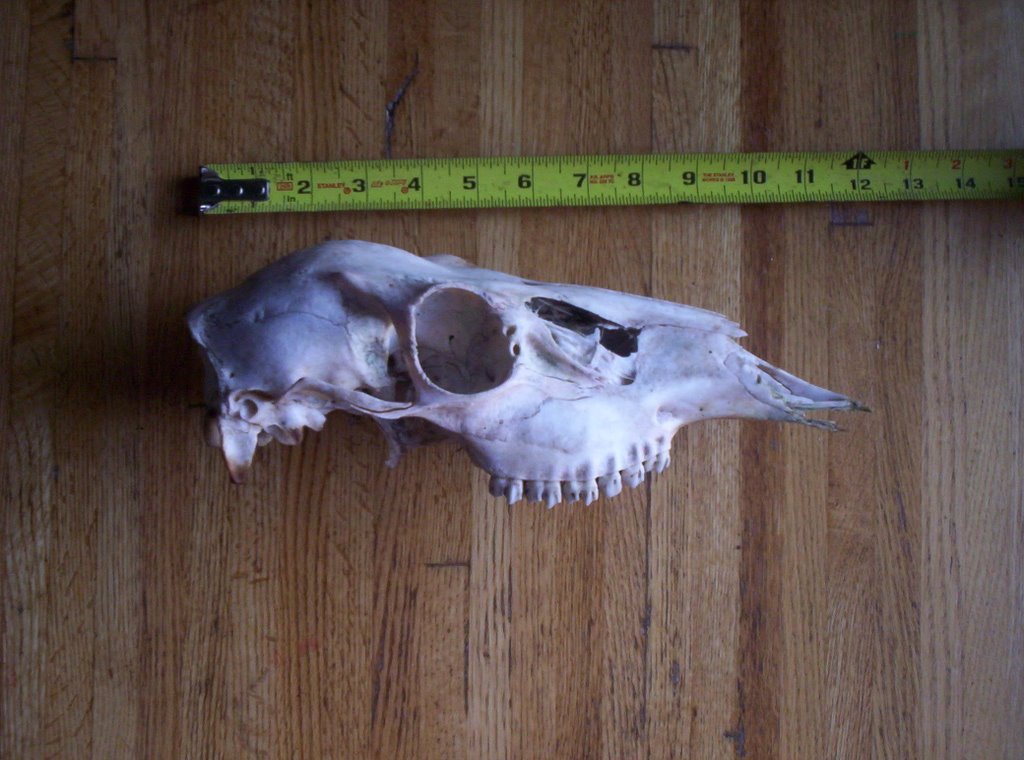
What kind is it?


This morning, I was out messing around in my study area (The study area is a circle with the diameter of 200 paces in your backyard that you get to know intimately through awareness and observation exercises. Getting to know this area really well is the backbone of the Kamana program.) and found this skull.

Does anyone want to take a stab at it and guess what it is?


And lastly, I recieved this petition about global warming in my email. I thought some of would be interested in checking it out.

Subject: Help Al Gore Send a Message to Congress


Hi,

Al Gore is ready to build on the success of "An Inconvenient Truth" and start organizing to solve the climate crisis. He's working to get hundreds of thousands of messages to Congress demanding real action to stop global warming. And he's asking for our help.

Can you help out by signing the petition at the link below? If you do, Al Gore will personally deliver our comments to Congress. I just did it myself and it only takes a second.

http://pol.moveon.org/climatecrisis/

Thanks!

Monday, December 11, 2006

The Economy is not Life Affirmative

There are times when I sit down with a book to thumb through it and pick out small excerpts to read. I did this other day with Derrick Jensen's book Welcome to the Machine: Science Surveillance and the Culture of Control. I ran across this in the footnotes section:

"Corporate crime, however defined and measured, is a small fraction of the subsidies that prop up what is called "free-market" capitalismTM. The whole economic system is actually based on subsidies, that is, the externalizations of cost. Indeed it's not to much to say that the primary purpose of government is to oversee and administer this process, and to neutralize or kill anyone who to strongly opposes it. The entire economy would collapse immediately without constant massive subsidies of money taken from the public as taxes and then handed over to various sectors of the economy as "incentives." These tax subsidies range from bailing out industries ( banks, airlines, auto manufacturers), to tax breaks (most of the largest corporations pay little or no corporate income tax), to the whole military-industrial complex. Tax subsidies cost American tax payers billions of dollars each year, but these are only tip of the externalization iceberg. Indirect subsidies are far more onerous. Work place injuries cost Americans more than $100 billion a year, and work place cancer costs us more like $300 billion. Price-fixing and false advertising costs American consumers more than $1 trillion a year. Air pollution causes more than $200 billion a year in health care. But these are only current monetary damages. See Ralph Estes, Tyranny of the Bottom Line: Why Corporations Make Good People do Bad Things. ( San Fransisco: Berrett-Koehler,1996), 177-78. The global trading system results in the transfer of wealth from the poor to the wealthy. When industrial civilization destroys the productive capacities of soils and forests, the reduction in productivity and the quality of life are passed on to future generations. The true costs of over-consumption by humans are also paid by other species, with their lives."

I read something like this and think how could it be any other way. Of course, I know there are other ways to be, but is somethinglike the complex global economy to hard for the masses to rationally undo? Is it because the whole thing is not founded on rational premises? I don't know. Another thought that comes to mind is that we work at jobs most of us would rather not be doing, wouldn't we rather be contributing to a system that is more life affirmative?

Sometimes it all seems to crazy to try and comprehend.

Saturday, December 02, 2006

Heaven?

Is this what heaven looks like for a technosalvationist?

Check out the first post by MatthewJ in this thread.

Also, here is an article in the New York Time titled: "The End of Ingenuity."

Here is a quote from it that I thought was pretty amazing considering the fact it's the New York Times.

"But in the larger sense, we really need to start thinking hard about how our societies — especially those that are already very rich — can maintain their social and political stability, and satisfy the aspirations of their citizens, when we can no longer count on endless economic growth."

There is a really good discussion talking about this article over at MetaFilter.

Monday, November 27, 2006

Connecting with the Land

The Wisconsin 9 day gun deer hunting season has come to an end. This was my twentieth season, and it was a good season. My brother-n-law, sister and I each got a deer, so we should have plenty of venison for the winter. Besides the fact that it was fun and successful season though, there was something missing in the experience. Actually there has been something missing in my life in general for quite some time now.

I really tried to put a finger on it this deer season, and I think I did. The other day, I was checking some blogs and ran across this post by Willem over at The College of Mythic Cartography. I need to add that I ran across this post within a day of really inquiring why I was feeling this way. I read it, and said that's it! It's really amazing how when one asks the universe a question the answer can show up within hours.

How do we truly return to the land? How do we break the back of our cultural addiction to machines and soulless systems?

Every time I’ve visited, as an adult, the sandy-soiled and salmonberry-blessed land of my childhood, in Coos Bay on the Southern Oregon Coast, I become overwhelmed with feelings that I even now can hardly articulate.

As a child I interacted with the landscape in such a directly tactile way, scratched, wet, cold, sun-kissed, wasp-stung, dirt underneath my fingernails. I had not much conception of the forest as a living being, my friends and I chopped wood and soil willy-nilly to build forts. And yet, through my memories, I know I saw the land as if through a golden medium, a strangely welcoming wildscape, stalked darkly by monsters, ghosts, and mysteries, at other times dizzy with sunlight and pine-pollen.

Nowadays the richness of my connection to the land has grown, but I notice a constant ache in the loss of that bodily-connection to the land from my childhood.

Somehow comforts of the modern age have muddled my senses, and I find myself amidst a constant urban battle between couch and copse, between warm box and wet greenscape.

More and more I become convinced of the vitality of other modes of Riddling-solving, beyond the conventional word based or “who-dunit”, but rather the wordless tactile riddles, such as how to climb that particular tree, and how many routes up it one can find. Or to find the source of a particular scent, or knowing when a wandering tickle under a pantleg belongs to the journey of a tick (perhaps they invented the “tickle”?), and when it simply belongs to a twitchy nerve.

Jon Young, the experienced animal tracker, mentor, and first student of Tom Brown, Jr., calls this kind of rediscovery of nature from a youthful perspective, “child’s passions”, and encourages anyone who seeks to reconnect to the land to first honor the repressed needs to reconnect in child-like play with the out-of-doors, in all its glorious discomforts and elations.


This "constant ache in the loss of that bodily-connection to the land" is what I think this incomplete feeling in me is. It's been there for a long time, it's just more pervasive when I spend a lot of time sitting quietly in the woods, like I did this deer season.

I grieve the loss.


Saturday, November 25, 2006

Derrick Jensen Update

Here are some of the things Derrick Jensen is working on and has available:

1) the news: I wrote an anti-zoo book. It's being published by a wonderful small press called No Voice Unheard. Their website is www.novoiceunheard.org. It will be out in the spring. The book consists of a long essay by me (which is available now through the reading club) and photos by the amazing photographer Karen Tweedy-Holmes. Her website is: http://www.tweedypix.com/

2) Some recent articles:


November 2006: interviewed online at Abolitionist-Online


Fall 2006: “The Lost Star Wars Script” (excerpt from Endgame) in Alternative Press Review

Fall 2006: “Irredeemable” (excerpt from Endgame) in On Edge (ms_t@riseup.net)

October 2006: To Give Our Brightest Deepest Truth

3) Updated schedule:


Wednesday, November 29, 7pm,

Where: Old Creamery Building

1251 Ninth Street
Arcata, CA

Who: Derrick Jensen
Lauren Regan, Attorney, Executive Director , Civil Liberties Defense Center
Mr. Mojo's Magic Puppet Troupe


Saturday Dec 9, 11am, I'll be interviewed on KYRS, Spokane, WA. It’s a low-power FM station, on 95.3 and on a translator at 92.3. It can be heard live online at www.kyrs.org


Thursday Jan 18, 730 pm, I'll be in Manila, CA (near Arcata and Eureka). Here's the information:

Gatherings With Authors

NOT just another series of book signings!

Every month, we will gather with a different author, who will share a brief reading from their book, followed by an opportunity to chat informally and buy a signed copy from the author. Then we'll reconvene with the author for another hour or two and delve more deeply into the ideas of that book.

Participants who confirm their attendance in advance will receive - by email - a chapter of the book so they can participate more actively in the dialogue.

Please sign up today to receive emailed reminders about each month's event at as this is the first of only two emails you will receive about this new author events series. (These events will not be publicized in the local press or via listservs, nor will you see flyers around town - publicity will be purely by word of mouth and by private email. Feel free to tell your friends, or forward this announcement to them.)

Attendees are welcome to arrive as early as 630pm to peruse the stacks in the 100fires home bookstore before the gathering begins at 730pm. Or phone us at 443-4483 anytime between 10am and 9pm daily to schedule a visit. We now have more than 2000 titles fully viewable and arranged into dozens of topics, from green building and feminism to US empire building and Native history, and everything in between. 100fires Books specializes in books, DVD's, and CD's to help create a healthier and more peaceful world. We're also online at http://www.100fires.com.

For more information, to receive a monthly email reminding you of upcoming author events, or to request an emailed copy of an excerpt from our next author's book (which will be sent about a week before each month's scheduled reading), please send an email to .

100fires Books is located at 1485 Peninsula Drive in Manila, and occupies the ground floor of Paul Cienfuegos' home. We're 1/4 mile south of the Manila Community Center. Watch for a two-story sage-green house with dark purple trim. The neighbors don't like strangers parking in front of their properties, so if there's no room in front of the house, please consider parking in the expansive Manila Community Center parking lot, and walking here. It's a lovely 4-minute walk. Or better yet, arrive here by bicycle, on foot, or by bus, and we'll give you 5% off anything you buy. And don't forget: we take Community Currency too - as 1/4 of your payment, on any purchase of $20 or more.

Be well,
Paul Cienfuegos
100fires Books
707 443-4483

April 17 or 18, I'll be in Arizona. Details to follow.

Thursday, June 14, 2007, I'll be part of the Orion Magazine Panel on the New, New Environmental Writing at the 2007 biennial conference of the Association for the Study of Literature and the Environment. The conference is at Wofford College in Spartanburg, South Carolina, June 12­16, 2007.My panel will be at 930 to 11 am, Thursday the 14th. Here is a website. More details to follow. http://www.woffordcollege.org/asle/

4) Marketing:

A) We have small stickers available for free for people who will put them up. You can see the stickers at www.whatgoesup.org. If you want some, send me a note and I'll get them out to you, if you promise to actually put them up.

B) Check out www.endgamethebook.org, which has information about my most recent release, Endgame.

C) There's going to be an endgame film festival, with a prize of $1000 for the best film that deals with: "There is a problem with civilization. The solutions require visionaries. Complete a film, video, or animation based on the ideas expressed in Derrick Jensen's book Endgame. ENDGAME International Film Festival is seeking work based on any ideas expressed in Endgame, OR any of the premises." There are also three secondary prizes of $250 each for most original film, most inspiring film, and best film by a young filmmaker. For information, please go to http://www.endgamefilmfest.org/

D) We're still in the process of getting T-shirts ready to sell. They'll have quotes either from my work or that I like, and also designs when appropriate. We've got tons of quotes to choose from, and we're starting with these three. The quotes we've settled on to start are "Now This War Has Two Sides" (which actually isn't mine, but from a late 1990s band: I learned of it when someone asked me to sign a book for him this way), "We have been too kind to those who are killing the planet. We have been inexcusably, unforgivably, insanely kind." and "Dismantle Globally, Renew Locally." One of the cool things is that the shirts are used but like new. We've ordered a bale of 100 pounds from a wholesaler, so it's even less environmentally destructive than had we got them organic and union-made (which we were going to do until we came up with the used idea). Since we don't yet have the shirts, this isn't on my website. The person where they sort the shirts says this is the slow time of year, and they are about 1/3 done collecting 100 pounds.

E) We're in the beginning process of putting together posters with my quotes on them. We should have that one ready to go within a few months.

F) If you have any ideas for quotes of mine you'd like to see on shirts, stickers, or posters, let me know and I'll put them in the pile of quotes we're considering.

G) I stil lhave that thing I mentioned about talking by telephone or webcame. Here's the poop on it, written for some reason in third person:
So many people have written to Derrick to ask if he can come to talk to their group in Valdosta, Georgia or Vancouver, British Columbia, or many other places across the United States, Canada, and the rest of the world. Many of these groups can't afford to pay his fees and expenses to fly all the way there and back, and he normally can't afford the time and expense to do it for free (he, too, has to pay rent).

So he's trying something new, which is that he's now available at a greatly reduced rate to talk by telephone or webcam with your book club, activist group, or other organization. It's a great way to meet like-minded people in your area, to ask questions, to explore, without the time (for him) and expense (for you) of flying him in for a lecture. He's also available for similar discussions at public venues like local/anarchist cafes, locally-owned, progressive restaurants or coffee houses, or other community spaces.

The fee for this is $100/hour, no matter the group size. If you're interested, send Derrick a note and the two of you can discuss details like when you'd like for this to happen and how it would work.

http://www.derrickjensen.org/telephone.html

H) You know of course that you can purchase my books at my website. I'm glad to sign them. I can give slight discounts for larger purchases. http://www.derrickjensen.org/purchase.html

I) Then there is the reading club. http://www.derrickjensen.org/readingclub.html That's where people can read my works in progress. I've got several books and several parts of books up there, and tons of essays, plus various other smaller documents that will never get published (like letters written to county officials protesting a development). Also I send out notes sometimes frequently and sometimes infrequently describing the things I'm working on, describing when I run into a problem, talking about why I made certain decisions in the stuff I'm writing, and so on. You get access to all of that. I came up with this idea a few years ago, and expected maybe one or two fanatics to sign up, but there are actually quite a LOT of people have signed up for it. I think it's pretty cool, and frankly it's the sort of thing I would have been interested in if I could have watched Mumford's process day by day (I upload stuff the day I write it, and so you can see the editing process too), or Mark Twain's, or John Steinbeck's. Maybe the first drafts of Susan Griffin's Woman and Nature were linear? Who knows?

Currently the major stuff up there you can read includes the anti-zoo book, two novels, a graphic novel written with Stephanie McMillan (www.minimumsecurity.net) one collection of interviews (the first one and last two of these are set for publication, the middle two are being shopped by my agent), as well as all the essays and stuff I mentioned before (including the introduction I wrote for the upcoming rerelease of Ward Churchill's Pacifism as Pathology).
. In addition there are a bunch of works in progress. These include two shortfilms I'm working on with Canadian filmmakers; a book about shit I'm writing with Aric McBay; another film I started working on, and then put on hold; another booklength project I started probably eight years ago that I'd forgotten about (The idea was that I would take a series of dreams over a few month period and turn them into vignettes. Then i would arrange them so they made some sort of sense. I only got through a few of them before I started work on some other project, probably Language, but then this spring I picked it back up and started to write the introduction. I think I got about 25 pages into it, or so).

Members of the reading club also get discounts on purchasing my books.

J) Then also there is the derrickjensen discussion list. It's at http://forum.derrickjensen.org/

Tuesday, November 21, 2006

Perspective on Oil Consumption

John Kurmann sent me this email talking about oil consumption. I think it really puts into perspective how much oil we've consumed in the past fifty years.

Good day, all. I came across the quote below in Byron W. King's Whiskey & Gunpowder newsletter for Agora Financial LLC (also published at http://energybulletin.net/22458.html). Though I was in some sense aware of the incredible rate at which global civilization is consuming petroleum, this somehow made the issue more concrete form for me. I also agree with Byron that it's well past time for us to get serious about addressing energy depletion. Here's the quote (emphasis added):

"...At a very basic level, people are beginning to wonder exactly how our society is going to heat its houses and grow and transport its food in about 20 years or so.

"Twenty years? Who cares, right? You scoff at such a time frame? For perspective, just understand that about 50% of all the petroleum ever consumed by mankind has been consumed since 1984. That is, people have been watching Tom Cruise movies and listening to Madonna sing for a longer time than it took to burn 500 billion barrels of petroleum. Talk about Nero fiddling? And about 90% of all the petroleum that has ever been consumed by mankind has been consumed since 1958. So 90% of the world's oil consumption has occurred in the time since the Beatles were a warm-up act in Liverpool. Does this not give you some sense of the rapidity of the developing energy storm? And if not now, just when is it going to be the right time to begin being concerned about the world's depleting energy supply over the next 20 years, let alone the next 50 years?"

--
"You never change things by fighting the existing reality. To change something, build a new model that makes the existing model obsolete." - R. Buckminister Fuller


Sunday, November 19, 2006

What's Your Outlook?

This Questionaire was put out by Portland Peak Oil.

A questionnaire on collapse

Hello fellow concern citizens,

There appears to be a great divide between possible problems and probable solution. I’ve yet to witness any sort of general consensus as to exactly what the general opinion is in regards to potential crisis even among those choosing to stay informed. So for anyone interested, I offer a general consensus building exercise; a crude questionnaire. Not for the general public, but for those of us, more naturally inclined to think about such things, or what Anthony Leiserowit referred to as “Alarmist”.

What follows is a two part survey. The first is “identifying the problems”; I’ve only mention what I consider to be the top five major problems (Climate Change, ecological collapse, energy scarcity, economic decline, and general collapse. I’ve intentionally avoided the political arena). They are numerical multiple choice, and are based on a point system.

For the following “identifying the problems”, please enter the number or numbers that correspond to your views (If say for climate change; you believe 3 to be probable as well as 9, the higher number trumps, all higher numbers are mutually exclusive to lower ones, but if say you think somewhere between 6 and 7, then 6 ½ will be your value.

The second part “identifying the solution”, there are ten choices to choose from, they are rather lengthy, and are roughly based on the five stages of grief. Please pick only one that you most agree with. If none apply, then please write your own. Please be mindful that the point of this exercise is to attempt to weed out the contradiction we all embody, and remember; that which makes you uncomfortable or offends is probably true.

At the very end, there is a section for your answers, I would please like you to copy, answer and email back to me. I’ll gather up all of your replies, average out everyone’s response, post them, and vuala!……….hopefully a slightly less vague understanding of each other.

Please be mindful to answer honestly, and if you’ve never really thought about it before, then please take your time and think about it before you do. There are seemingly minute distinctions between a lot of the choices, but those very distinctions tend to reflect the devil in the details as to our true feelings. Either we believe things to be ok, or not, and if they’re not, then just how bad do we think they are?

Identifying the problem(s)

Side note: Remember civilization doesn’t connote humanity. The rise and fall of numerous civilizations is just one aspect in the history of humanity. Here “humanity” equates to our very existence as a species, as where “civilization”, equates to our current means of extraction of raw materials, production, consumption, transportation, communication, urban and rural civil infrastructure, basically our industrial and technological way of life.

Climate Change: The largest body of peer-review scientists in the history of civilization (I.P.C.C.) are 95% certain the earth will increase by 3*C by 2100 regardless of any CO2 emissions reduction. And this doesn’t even factor in positive feedback loops, which will almost certainly dramatically increase the rate of change. Again, a 2*C increase is considered to be the point of no return in regards to run away Climate Change and/or abrupt Climate Change.

Therefore Climate Change will either:

1. Have no affect on civilization
2. Barely affect civilization
3. Moderately affect civilization
4. Seriously impact civilization beyond our current understanding of what civilization means
5. Seriously impact civilization, but nothing approaching collapse
6. Seriously impact civilization up to the point of collapse
7. Eventually collapse civilization
8. Collapse civilization within our lifetimes
9. Eventually destroy humanity
10. Destroy humanity within our lifetimes

Ecological collapse i.e., over population, water scarcity/drought, poverty, destruction of both the tropical and temperate rainforests, acidification of the oceans, habitat destruction, soil erosion, desertification, water and air pollution, mass extinction, etc.

Therefore ecological destruction is either:

1. A non-issue
2. Going to minimally impact civilization
3. Going to moderately impact civilization
4. Going to severely impact civilization
5. Already is severely impacting civilization
6. A domino effect that “will” moderately collapse civilization
7. A domino effect that “is” moderately collapsing civilization
8. A domino effect that will eventually totally collapse civilization
9. A domino effect that will totally collapse civilization within our lifetimes
10. A domino effect that will eventually destroy humanity
11. A domino effect that will destroy humanity within our lifetimes

Energy scarcity: The peaking and permanent decline of crude oil and natural gas around 2010, with no alternatives even remotely capable of replacing them, which will have a resultant devastating impact on global economic growth and the global economy.

Therefore energy scarcity will either:

1. Be a non-issue
2. Only minimally impact civilization
3. Only moderately impact civilization
4. Severely impact civilization
5. Eventually collapse civilization
6. Collapse civilization within our lifetimes

Economic decline in the U.S.: $ 8,550,658,088,146 national debt (as of Oct 11th), and borrowing $2 billion a day; a $191 billion trade deficit; a devaluing dollar/petrol dollar; an over-inflated housing market; outsourcing of the manufacturing and high tech job markets; dwindling middle class wages; an ever increasing lower income class; continued privatization of common wealth; corporate deregulation; impotent antitrust laws; mass media conglomeration; increased health costs; increasing insurance costs; a polarized one political party system; corporate campaign funding; over fifty cents on every U.S. tax dollar going to the un-auditable military-industrial-complex “accounting” office in the Pentagon; the outright theft of the last two presidential elections; the U.S. governments complicity in the 9/11 attacks. Not failing to mention the impact both climate change and energy scarcity will have not only on the U.S. economy, but the entire global economy

Therefore economic decline:

1. Will be a non-issue
2. Will minimally affect our daily lives
3. Will moderately affect our daily lives in the distant future
4. Will moderately affect our daily lives in the near future
5. Is moderately affecting our daily lives
6. Will severely affect our daily lives in the distant future
7. Will severely affect our daily lives in the near future
8. Is severely affecting our daily lives
9. Will eventually collapse the U.S. economy
10. Is currently collapsing the U.S. economy
11. Will eventually collapse the global economy
12. Is currently collapsing the global economy
13. Will eventually collapse civilization
14. Is currently collapsing civilization
15. Will collapse civilization within our lifetimes

Collapse: All of the above along with several hundred other distressing issues not mentioned

Therefore:

1. The future “objectively” looks bright, positive, wonderful and all this talk about collapse is absurd and ridiculous.
2. There’s really no reason to worry, it will somehow all work itself out in the end.
3. Humanity has always been confronted with adversity, and just as before we will discover a way to overcome these new challenges, there are no problems, only solutions.
4. The fundamental constructs of civilization are in question and we need to eventually change how we approach things.
5. Civilization has “serious problems” and if we don’t drastically change our behavior, we might be in for a rough ride.
6. Civilization is “seriously flawed” and needs to be rebuilt from the grass roots up immediately.
7. Civilization is “inherently flawed” and will eventually collapse
8. Civilization is collapsing.
9. Civilization is inherently flawed and will collapse within our lifetimes.
10. Humanity is inherently flawed and we will eventually destroy ourselves.
11. Humanity is inherently flawed and we will destroy ourselves within our lifetimes.

Another general overview of collapse just worded differently:

1. I am an instrument of god's will
2. We are all in god's hands
3. Civilization is infinitely dynamic and adaptable, and will make what ever needed adjustments are required to assure our continued success.
4. Human ingenuity is limitless and capable of overcoming any adversity.
5. Civilizations technological achievements will eventually develop any solution to any challenge before us just as it has continued to do since the dawn of civilization.
6. Life is in a continuing state of flux, between life and death; we’ve always taken two steps forward and one step back.
7. Life is indefinable and imperceptible, all of life ebbs and flow, we are but in an endless state of transition and evolution, the future has always been uncertain.
8. We are capable of great change if we so choose, we are equally capable of enormous destruction, what will be are fate is anyone’s guess.
9. We are being confronted by serious challenges that are demanding serious changes in how we live and interact, if we do not begin to change our behavior soon, we will be in serious trouble.
10. The challenges ahead may be without a solution, but I believe we will somehow overcome these problems.
11. The challenges we are being faced with have probably never been so severe, we must change our way of living immediately if we want to avoid catastrophe.
12. The problems we are facing will never be solved by the people who created them; we must take it upon ourselves to be the change we want to see.
13. The dilemma we are in now is really no different than any time before, but now we’ve reached the outer limits of discovering solutions.
14. The crisis before us is unprecedented and will require unprecedented change if we hope to overcome the single greatest catastrophe in the history of civilization.
15. The crisis before today, scientists have been describing for decades, we’ve done nothing to change the coarse we’re on, and are now meeting our fate.
16. The catastrophe now in affect will “eventually” collapse civilization.
17. The catastrophic consequences of our negligence will collapse civilization “within our lifetime”.
18. The disaster fast approaching will devastate those who are unable and/or unwilling to prepare.
19. Climate Change will not only collapse civilization within our lifetime, but will as well, nearly destroy humanity.
20. Climate Change will nearly destroy humanity within our lifetime.

Identifying the solutions

Side note: Identifying the solutions is so completely interconnected to identifying the problems, that in many ways they become one in the same, similar to the interconnection between cause and effect.

Please choose just one of the following ten options.

1: Problem, what problem? There is no need for concern or change in our way of life and living, we are all in god’s hands, and as long as we take strength in prayer and hope for the best, everything will be as it has always been, or as god intends. We will all live long prosperous lives, for civilization through its continuous technological progress, will only go on to provide ever abundant and rich future prospects for all of mankind. Metaphorically: Life is but a glorious cruse.

2: There is no cause for us to alter our individual lives, although I recognize there are things that do need to change, but you know what they say, “the only thing constant in life is change”. No one knows what the future holds. Scientists can no more predict the climate a hundred years from now, than weathermen can predict the weather next week. There is always room for improvements, and civilization will eventually solve whatever problems may arise; besides necessity is the mother of invention. Metaphorically: This ship is unsinkable.

3: Who do they think they are to make such outrageous claims? I can’t stand people like them; all holier than thou. They always find some reason to be angry and disappointed, always pointing their finger at others and telling them how to live. They should first ask themselves what they are getting out of all this fear mongering. I’m sick of their doom-saying, just let me be. I can’t believe I’m having to have to deal with this. Science is fallible and in many ways plain wrong. One can always find fault, we live in an imperfect world. Who are they to tell me my world view is wrong, my god is dead; my faith is false, my life is a mistaken or civilization is going to collapse? What do they suppose I tell my children, that we‘re all going to die tomorrow? We only have one life to live, if they want to go through it constantly being pessimistic about everything, and not accepting the way things are, then they can go to hell. Metaphorically: What is all this talk about icebergs, it’s really spoiling my trip. The Captain knows these waters well, and just look at the size of this ship, you must be crazy to think they would ever let anything happen to us.

4: This is not my problem. I’ve got more important things to think about, besides what can anyone do to really make a difference? Why should I be punished for just wanting to do well? What about my desires? Haven’t I the right to be happy? “God helps those who help themselves”. I recognize that there are certain problems that relate to how we live in some aspects, but it is not my responsibility to save the world, besides what ever problems there are, they won’t happen in my life time. Metaphorically: We may or may not be able to turn the ship around, but for the most part, I’m just going to enjoy the ride while it lasts.

5: I am aware that there are many difficult problems; there have always been problems, as well as solutions. This is a wonderful opportunity to finally build sustainable communities, and renewable resources that we’ve needed to do for decades, now is the time for change. If we all just wake up and pull together, “we can be the change we want to see”. I believe that society is capable of waking up, and is, waking up to these new challenges, and we will make the appropriate changes to alter the direction we are on, and that though the road ahead maybe bumpy and possibly treacherous, and though I admit there is great cause for concern, I believe we will find a new path and create new ways of living. A certain amount of denial isn’t necessarily a bad thing. For me hope is crucial in remaining optimistic, so regardless of what happens I’ll continue to look on the bright side of life. The love we receive is equal to the love we give, change starts with ourselves. Metaphorically: By voting progressive, recycling, conserving, staying informed and making a few personal sacrifices we might somehow, someday turn the ship around.

6: Well it could be worse. I recognize that there are very serious problems, when hasn’t there been? Who ever said it was going to be easy? But to be honest, I am utterly torn between knowing that I need to make some serious changes, and just wanting it all to go away. I know I’m doing my best, and that unfortunately, it’s still more than most, but there is whole lot of shit coming down that’s hitting people hard. I believe we are about to see a great transition in how we approach most everything. While the older I get, the more cynical I become that we can change the coarse we’re on, I still believe there are many causes for hope, as well as many new technological advancements breaking ground that will completely change the way we live. The world is finally waking up from its long slumber, and I believe we’ve still enough time to make things right or at least reduce a lot of the problems. It is less a question of our ability, than it is our will. I hope that it will not require something catastrophic to happen that finally forces us to make those serious changes. I believe that things have probably never been as bad as they are today, but I try to remain hopeful that somehow things will work themselves out, besides what’s the point of living, if you just dwell on the negative all the time? But ultimately, even if we don’t change, what difference does it really make in the end? We’re all just star dust after all. Life simply is. Metaphorically: We’re old hands at this game called life, for some reason we’ve a disposition for presuming the worse. I understand why the Titanic metaphor is so popular, for it definitely seems that something very dark is up ahead, but we’ve been using that ship to describe the present for over seventy five years, yet here we are, still plodding along, and even if we do crash it’s not like we haven’t cashed before.

7: Obviously there are enormous problems facing us, and they will only continue to probably get worse. I know I could be being doing more, but I don’t believe it will make a bit of difference. The magnitude of our current situation is so emotionally overpowering, that when I do contemplate the greater cause, effect and solution to the problems, I’m so completely distraught, that I just mentally shut down, and am wanting of anything to distract me from such depressing thoughts. Being constantly mindful of current events makes living day-to-day very difficult. To be completely honest, I’ll probably just continue to go about my life much as I have always done, why not? When hasn’t the world been on the eve of destruction? If not Climate Change, then nuclear annihilation, the hole in the ozone, bird flu, AIDS or some other god awful manmade creation. Yes, I fully recognize that there are incredible problems facing both civilization and humanity, and it appears that the world’s governments are either unwilling and/or unable to do anything about it, and people are just too afraid and apathetic to change. I don’t know what I can do to really change anything accept just go about my life and try not to be apart of the problem. Metaphorically: The ship is still full steam ahead, I can see the iceberg, the captain is a gambling drunk passed out over the helm, and the door is locked. The ship may or may not go down, and to honest, I don’t really care either way, I’ve got my lifejacket, there’s no point of worrying more than I already do, life is challenging enough without having to plan for the worst case scenario.

8: The problems we face are in many ways the same problems we’ve always faced, except where instead of there only being a few million to hundred million people destroying the commons, much as we’ve been doing over the entire history of humanity. We are now, nearing the tail end of exponential population growth unto nine billion, with all of its associative destructive manifestations, and where we’ve overshot the earth’s carrying capacity now by over 20%. No amount of political or economic mitigation can possibly counter the enormous impact of our sheer physical footprint on a finite and fragile environment. The best we can hope for is that some ecological catastrophic event occurs that so impacts our perception of reality, that humanity is forced to change virtually every aspect of civilization overnight. I’ll wait and see how bad things get before I decide what I want to do. Metaphorically: Humanity is a ship that breached well before we were even born, it’s just taken decades to capsize, and there are no lifeboats in this metaphor. And even though I can swim, I’ll die of hypothermia within minutes. So I think I’ll just head for the bar, drink the top shelf, and watch the whole shithouse go down.

9: Given that humanity has had every opportunity and imperative to achieve social equity, equality, social justice, environmentally sound development, global peace and harmony over the last twenty five hundred years of enlightened civil accord. And where we have obviously failed to do so in relative times of natural abundance, it is therefore preposterous to presume that now given the reality of catastrophic climate change, severe environmental degradation and perpetual resource scarcity, etc —as a direct consequence of exponential over-population—that civilization will be able to overcome the very endemic behaviorism which has prevented us from achieving such said goals thus far. We’ve known for over two decades that civilization must curtail CO2 emissions before “positive feedback loops” are tipped, triggering unstoppable Climate Change that will not only collapse civilization, but virtually destroy all of life on earth. Aside from many of these positive feedbacks having already been triggered, the general scientific consensus is that a 2*C increase is the “point of no return”. The largest scientific body of research in history of civilization, has now determined that regardless of mitigation, the earth will increase by 3*C. In concert with a litany of global unprecedented catastrophic events which have no foreseeable solution, collapse is not only inevitable, but is now transpiring and will only continue for the remainder of our lives. Metaphorically: The ship is going down, no one is coming to the rescue, there are no lifeboats, while most everyone are in the chapel praying for salvation, a few have their lifejackets on, and are standing on the edge waiting to jump, while others are gathered in the ballroom, either dancing there hearts away, enjoying their last meal or getting drunk. I am standing in middle of it all, unable to make up my mind; the music sounds so good and I love to dance, but I am hungry as well, and for god’s sake I could definitely use a drink, but I can’t help but notice the ax hanging on the wall behind that rather large wooden bar.

10: In acceptance of 9 being true. From an ecological, economic and political standpoint, collapse is not only inevitable, but unfortunately now necessary. The near millennial global institutions which humanity has created are not only systemically problematic, but owe there very existence to our cultural endemic false perceptions of reality, where we ignorantly perceive perpetual growth as being feasible in a finite biosphere. As long as our general social indoctrination of competition over cooperation prevails, true change is impossible. Nothing will eradicate that thinking more than a few billion deaths. While it is an incredibly grim prospect, that the planet is over-populated by billions of people, if we’ve any hope of surviving as a species—not to mention the rest of life on the planet—we simply must reconstitute our very existence, into entirely new social orders of incredibly less energy inputs and ecological impact. The only way this is physically possible, is for humanity to either practice volunteered simplicity, where we learn to live on far less, and that which we do live on, we provide for ourselves, or Mother Nature will teach us to simply live the hard way. Metaphorically: How are we going to get that bar out through those doors?

So please copy from here down, and email your answers back to me.

Identifying the problem:

For Climate Change I believe:
For ecological collapse I believe:
For energy scarcity I believe:
For economic decline I believe:
General world view:

Identifying the solution:

I consider___to best represent my outlook as to future recourse

Wednesday, November 15, 2006

Amazing Essay

How different would the world look if we percieved it with all of our senses?

Here is what I think is an important essay by David Abram talking about how "the fate of the earth depends on a return to our senses."

It's good!

Wednesday, November 08, 2006

Voting

I voted yesterday. I wasn't going to, but it is a nasty habit I just can't seem to break. I voted a straight Green ticket even though I want less government in my life. The Green Party candidates were the only ones in my area that even mentioned Peak Oil.

Here is a quote from over at IshCon by treemeat that sums up why I voted.

I always participate in the electoral process even though I'm anti-government and I know we don't live in functioning democracies to begin with. I vote for the Green Party as a protest vote and every federal election the party gets more votes and attention and this causes the major parties to start adjusting their policies to attract our votes to form a majority government. It's a fucking slow strategy but it's not like voting takes up a lot of energy and I figure it's better to interact with this broken system in the little way that I can.


Ran Prieur imagines "what would happen if everybody, instead of voting, planted a single food-bearing tree."

Personally, I think the world would be a better place.

Tuesday, November 07, 2006

Internet Forums, Spirits and Science

Lately, I've been doing a lot of reading on the internet. What has really piqued my interest is a couple of threads over at IshCon. One thread is talking about what spirits are and the other is talking about the relationships scientists have with the creatures they're observing. Both threads are really good. I highly recommend checking them out.

This picture comes to mind when thinking about the relationship between observed and observer.

And on the subject of Animism. I was reading a few chapters out of Derrick Jensen's amazing book Walking on Water and ran across this small section that I think relates to the living harmonic Shirin was talking about in Daniel Quinn's book, The Story of B.

"Of course not. Everyone knows our bodies aren't really where we live: our bodies are kind of like TV receivers. Imagine if you'd never seen a television before, and you walked into a room and saw it on. You might think the Red Sox and the Mariners are actually a bunch of little people running around inside, as though it's a tiny stage or a tiny world. You remmeber those old RCA Victor ads where the dog thinks a human being is talking, but it's really a record player, right?."

Most remember. Some don't remember record players.

I continue nonetheless, "Maybe we only think our bodies are where the action takes place, but instead our bodies are complex receivers that play out the energy that's everywhere, kind of like the radio and television waves that surround us but do not become perceptible to us until the waves encounter receivers tuned to the right frequency."

"You mean space aliens beam us into existence?"

"No, silly, life itself. It's dancing and exploding all around us, and when the right wavelength meets the right vessel, boom, there you go, instant animation. Instant person. Or tree or frog or rock. All each of us is doing is manifesting in our own particular way the life force that surrounds us all. We don't really think with our brains, anymore than the Mariners live inside a television. That's just where it comes into focus."